

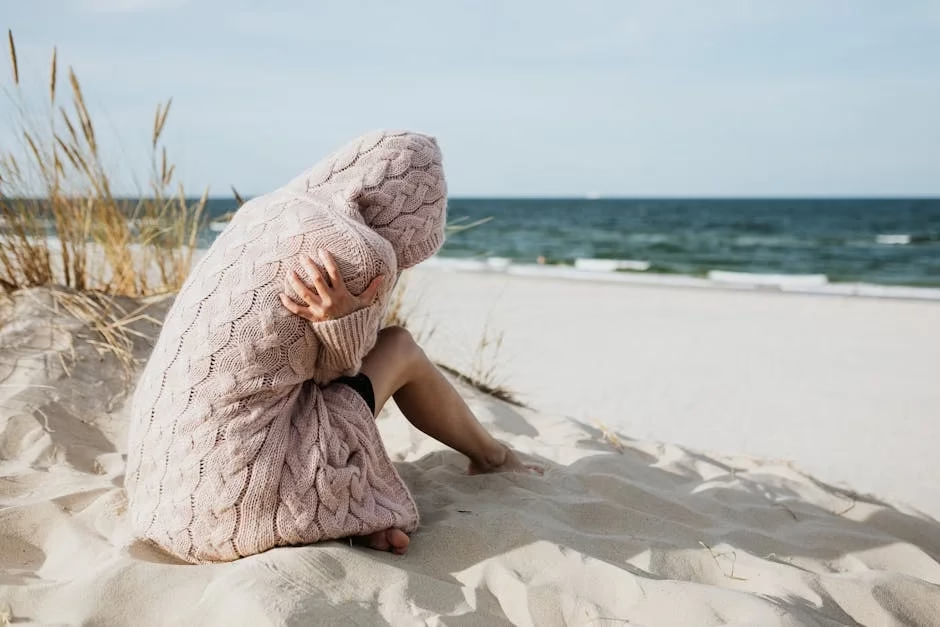
Your shoulders are up near your ears. Your jaw is tight. Your thoughts are moving too fast to catch, and you’re not even sure what started it. That feeling — that whole-body, whole-mind sense of being on high alert — is something around 301 million people worldwide live with, according to the World Health Organization. You are not alone in this, not even close — and the right relaxation techniques for anxiety can bring real, lasting relief.
Here’s the thing most anxiety advice gets wrong: it treats all anxiety the same. But the tight chest and shallow breathing of a panic moment needs something completely different from the low hum of worried thoughts keeping you awake at midnight. The right relaxation techniques for anxiety depend on what kind of anxious you are right now — physically tense, mentally spiraling, sensory-overwhelmed, or somewhere in between.
This post walks you through the most effective evidence-backed tools, and more importantly, helps you figure out which one actually fits what you’re feeling. No one-size-fits-all advice here. Just practical, honest guidance you can use today.
Relevant blog to read: Effective Breathing Techniques to Reduce Anxiety
Table of contents
- Why Anxiety Changes Your Body Before It Changes Your Mind
- When Your Body Feels the Anxiety Most: Try Deep Breathing or Progressive Muscle Relaxation
- When Your Thoughts Won't Slow Down: Try Grounding Techniques
- When You Need to Feel Safe Again: Try Guided Imagery
- The One Thing Most People Get Wrong About Relaxation
- Building a Daily Relaxation Habit That Sticks
- Frequently Asked Questions
- Sources & Further Reading>Author's note
Why Anxiety Changes Your Body Before It Changes Your Mind
When something feels threatening — even if it’s just a difficult email or a crowded train — your brain sends a signal that puts your whole body on alert. Your heart beats faster. Your breathing gets shallow and quick. Your muscles tighten up, ready to run or fight. This is your nervous system doing exactly what it’s designed to do. The problem is, it often fires up when there’s no actual danger to escape from.
That’s why relaxation techniques work from the body upward. When you slow your breath, soften your muscles, or anchor your senses in something real and present, you’re sending a signal back to your nervous system that says: we’re safe. You don’t have to force calm. You just have to give your body enough gentle input to shift gears on its own.
Understanding this matters because it changes how you approach these tools. You’re not fighting your anxiety. You’re working with your nervous system, not against it.
When Your Body Feels the Anxiety Most: Try Deep Breathing or Progressive Muscle Relaxation
You know the kind of anxiety that lives in your body? The tight shoulders, the clenched jaw, the restless legs that can’t stay still? That’s your nervous system holding on. Two techniques speak directly to that kind of tension.
Deep Breathing for Anxiety
When anxiety hits, your breathing naturally becomes fast and shallow — which actually keeps the alarm bells ringing. Slowing your breath down sends a calming message to your brain. The NHS recommends practicing slow breathing for at least five minutes to help reduce stress symptoms, and the good news is you don’t need any special technique to start.
Here’s how to try it gently:
- Breathe into your belly, not your chest. Place one hand on your stomach. When you inhale, let your belly rise. That’s diaphragmatic breathing — it’s the most calming kind.
- Try a gentle rhythm. A four-count inhale and a four-count exhale works well for many people. But if counting feels stressful, just slow down without the numbers. It still works.
- Don’t force it. Pushing too hard to breathe deeply can actually make things worse. Keep it soft, not effortful. If it feels uncomfortable, ease off.
- Practice when you’re already calm. The trick with breathing exercises for anxiety and stress is that they’re harder to access when you’re in the thick of it. Five minutes of belly breathing once a day — before the anxiety hits — trains your body to respond faster when it does.
Progressive Muscle Relaxation for Anxiety
This one might sound a bit odd at first: deliberately tensing your muscles so you can release them. But there’s a real reason it works. Most of us carry tension we’ve stopped noticing. Progressive muscle relaxation for anxiety teaches you to recognise that contrast — the difference between a muscle that’s gripping and one that’s let go.
- Start at your feet. Squeeze the muscles in your feet tightly for five seconds, then release completely. Notice the difference.
- Move slowly upward. Work through your calves, thighs, stomach, hands, arms, shoulders, and face — tensing and releasing each group.
- Breathe through it. Exhale as you release each muscle group. That pairing of breath and release deepens the effect.
- Pay attention to your jaw and shoulders. These are where most people hide the most tension without realising it.
Harvard Health notes that progressive muscle relaxation is one of the most widely recommended approaches for reducing physical stress and tension — and it’s something you can practice lying in bed, sitting in a chair, or anywhere you have a few quiet minutes.
When Your Thoughts Won’t Slow Down: Try Grounding Techniques
Sometimes anxiety isn’t about physical tension at all. It’s the mental kind — thoughts looping, worst-case scenarios stacking up, your mind racing somewhere you don’t want to go. Grounding techniques for anxiety are built for exactly this moment.
Grounding works by pulling your attention out of your thoughts and into the present moment — specifically, into what your senses can actually detect right now. It interrupts the spiral by giving your brain something real and immediate to focus on instead of hypothetical disasters.
The most well-known grounding tool is the 5-4-3-2-1 method:
- Name 5 things you can see around you right now.
- Name 4 things you can physically feel — your feet on the floor, your clothes on your skin.
- Name 3 things you can hear — even distant or small sounds.
- Name 2 things you can smell — or notice the absence of smell.
- Name 1 thing you can taste.
It sounds deceptively simple. But walking through your senses one by one forces your brain to engage with what’s actually here — not what might happen. This is especially useful when the spiral starts somewhere you can’t easily leave: the supermarket checkout, a packed train carriage, a waiting room chair where you’ve been sitting too long. Somewhere public, somewhere you have to hold it together. That’s exactly when this works.
When You Need to Feel Safe Again: Try Guided Imagery
Guided imagery for anxiety relief is less about distraction and more about restoration. The idea is to give your nervous system a place to land — somewhere that feels genuinely calm and safe — using the full detail of your imagination.
Research suggests that imagery works best when the scene is rich in sensory detail, not just a vague visual. A beach isn’t enough. You need the specific weight of warm sand under your palms. The way a wave pulls back and goes quiet for just a moment before the next one comes. The particular smell of salt and something faintly green. That’s what your nervous system actually responds to — not the idea of calm, but the felt texture of it.
- Choose a place that genuinely calms you. It could be somewhere you’ve been, or somewhere entirely imagined. A childhood garden, a quiet forest, a cosy room by a fire — whatever feels like safety to you.
- Build it with all five senses. What do you see, hear, feel, smell, and taste there? The more specific, the better.
- Rehearse it when you’re already calm. The more familiar the scene becomes, the easier it is to access when anxiety rises.
- Use a recorded guide if you find it hard to stay focused. There are many free audio guides that walk you through the imagery step by step, which removes the effort of self-directing the experience.
This approach tends to suit people who respond naturally to mental imagery — those who find their mind drifting into pictures and scenes easily. If that’s you, guided imagery could become one of your most powerful tools.
The One Thing Most People Get Wrong About Relaxation
Here’s the insight that genuinely changes things: these techniques work best when you practice them before you need them. Most people reach for a breathing exercise or a grounding tool only when anxiety has already peaked — and then feel frustrated when it doesn’t work fast enough.
Think of it like learning to drive. You don’t want your first time behind the wheel to be in a thunderstorm on a motorway. You practice in calm conditions so the skill becomes automatic. Relaxation works the same way. A few minutes of belly breathing once a day — while you’re making coffee, before you fall asleep, after you brush your teeth — builds the neural habit so your body can find it when everything feels harder.
This also means that if a technique doesn’t work the first time under stress, that’s not a sign it won’t work for you. It may simply need more calm-weather practice first.
There’s no single best technique. Some people calm down fastest with breathing exercises for anxiety and stress. Others need to move through their muscles. Others need to anchor in their senses, or escape into imagery. The most effective relaxation plan is the one that matches your anxiety — and that you’ll actually come back to, day after day, even when things feel okay.
Building a Daily Relaxation Habit That Sticks
The most powerful relaxation techniques for anxiety aren’t the ones you save for a crisis — they’re the small practices you return to on ordinary days. When calm becomes a habit rather than a rescue, your baseline nervous system gradually settles. Here’s how to make it stick.
- Anchor it to something you already do. Three slow breaths before your morning coffee, or a body scan as you get into bed, are far easier to keep up than a separate “session.”
- Start absurdly small. Two minutes counts. A tiny practice you actually do beats a perfect one you skip.
- Practise when you’re calm, not only when you’re panicking. Rehearsing these tools on good days means your body knows the path when a hard moment hits.
- Track how you feel, gently. A one-line note on your mood helps you notice the slow, real shift over weeks.
Over time, these repeated moments of calm retrain how your body responds to stress. If the physical side of anxiety hits you hardest, you may also find comfort in calming an activated nervous system.
Frequently Asked Questions
Slow belly breathing is one of the quickest tools available because it directly signals your nervous system to calm down. Try placing one hand on your stomach and taking a slow four-count inhale, then a gentle four-count exhale. Even two or three minutes of this can begin to ease the physical symptoms of anxiety. Grounding with the 5-4-3-2-1 technique is another fast option when thoughts are racing.
Yes — and there's a clear reason why. When you're anxious, your breathing naturally becomes fast and shallow, which keeps your nervous system in high-alert mode. Slowing your breath down sends a calming signal back to your brain. The NHS recommends at least five minutes of slow breathing to help reduce stress symptoms. It works best when practiced gently and regularly, rather than forced during a peak moment.
It's a grounding exercise that pulls your attention away from anxious thoughts and into your present surroundings using all five senses. You name five things you can see, four you can feel, three you can hear, two you can smell, and one you can taste. It works by giving your brain something real and immediate to focus on, which interrupts the loop of worried or catastrophic thinking. It's especially helpful in overwhelming environments.
When panic symptoms hit — racing heart, tight chest, shallow breathing — grounding and gentle breathing tend to be the most effective first steps. Slow belly breathing helps calm the physical response, while the 5-4-3-2-1 grounding exercise anchors you in the present moment and interrupts escalating thoughts. Avoid forcing deep breaths, as this can sometimes increase discomfort. Start small and let the technique work gradually rather than trying to push calm to arrive instantly.
It depends on where your anxiety shows up most. If it lives in your body — tight muscles, jaw tension, restlessness — progressive muscle relaxation or deep breathing may suit you best. If it's mostly in your thoughts — racing mind, worst-case thinking — try grounding techniques. If you respond well to mental imagery, guided imagery could be powerful. Many people find that trying a few approaches in calm moments, not crisis ones, helps them discover what fits.
Author’s note
Thank you for taking the time to focus on your well-being and for being your own cheerleader in this journey called life. I truly appreciate you for choosing to invest in yourself today, and I’m honored that you spent a part of your day here. Remember, every small step you take matters, and you’re doing an amazing job. Keep going—you’ve got this!


One Comment