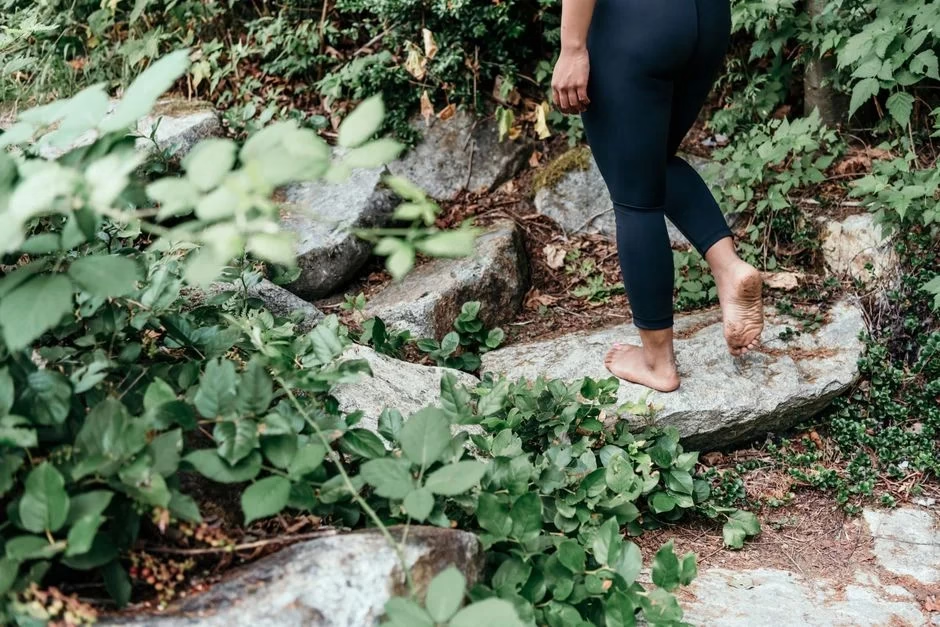
Your mind is somewhere else entirely. You’re walking to the kitchen, to your car, down the street — and your brain is three hours ahead, replaying a difficult conversation, or quietly catastrophising about something you can’t control. Your body is moving, but you’re not really there.
That gap between your body and your mind is where stress lives. And here’s what most people don’t realise: the walk you’re already taking every day could be the thing that closes it. Mindful walking doesn’t require a forest, a wellness retreat, or forty-five minutes of free time. It just requires you to show up, for a few minutes, to what’s already happening.
This post will walk you through what mindful walking actually is, why it works on a brain level, what the research says, and how to start today — even if you live in a city, even if you’ve never meditated a day in your life.
Relevant blog to read: Stress Resilience Strategies That Actually Work
Table of contents
- Why Your Brain Gets Stuck — and Why Walking Can Help
- What Mindful Walking Actually Is (It's Simpler Than You Think)
- The Mindful Walking Benefits That Surprised Researchers
- How to Start a Guided Mindful Walking Practice Today
- The One Thing That Makes Mindful Walking for Stress Actually Stick
- Frequently Asked Questions
- Related Reading
- Author's note
Why Your Brain Gets Stuck — and Why Walking Can Help
When you’re stressed, your brain defaults to something called rumination. That’s the mental loop where you replay problems, rehearse arguments, or worry about things you can’t change. It feels productive, like you’re solving something — but mostly it just drains you.
Here’s the thing about rumination: it needs your attention to survive. It feeds on a mind that has nothing else to focus on. And that’s exactly where mindful walking comes in. When you give your attention something real and physical to anchor to — the feel of the ground under your feet, the sound of your own breathing, the temperature of the air — you gently pull it away from the loop.
This isn’t about forcing yourself to think happy thoughts. It’s about giving your brain a different job, one that’s grounded in the present moment rather than stuck in the past or future. Studies in university students found that even a single guided mindful walk significantly reduced both state anxiety and state stress — not after weeks of practice, but after one walk. That’s a meaningful finding, because it means the benefits can start the very first time you try.
What Mindful Walking Actually Is (It’s Simpler Than You Think)
Mindful walking is not power-walking with your eyes half-closed. It’s not a performance. It’s not about achieving perfect zen focus while strangers walk past you on their lunch break.
It’s simply walking — while paying attention on purpose. You notice what your body is doing, what your senses are picking up, and when your mind wanders, you gently bring it back. That’s it. The “bringing it back” part is actually the practice. Every time you notice your mind has drifted and you return your focus to the walk, you’re strengthening your brain’s ability to regulate attention. Think of it like a bicep curl for your mind — the resistance is the distraction, and the return is the rep.
A mental health professional would frame it this way: the goal isn’t to empty your mind. It’s to notice thoughts and sensations without judging them, and then gently return your attention to the walk. That non-judgmental quality matters. You’re not failing when your mind wanders. You’re practising.
The Mindful Walking Benefits That Surprised Researchers
The research on mindful walking is still growing, but what’s already there is genuinely encouraging — and some of it is surprising.
- Stress and anxiety relief: A 2024 study in university students found that a guided mindful walk significantly increased state mindfulness and reduced both state anxiety and state stress. One walk. Real results.
- Longer-term wellbeing: A randomised controlled study in psychologically distressed adults found that a 4-week mindful walking programme reduced perceived psychological distress and improved quality of life compared with no intervention at all.
- It works in cities too: One of the most common assumptions is that mindful walking only works somewhere beautiful and green. But research found that mindful outdoor walking improved sleep quality, mood, and mindfulness in both natural and urban environments — with no significant advantage for the natural route. The setting matters less than the practice.
- Mood and attention together: There’s evidence of a reinforcing loop — when attention improves, mood tends to lift, and when mood lifts, it becomes easier to stay present. Mindful walking seems to trigger both at once.
- A broader picture: A 2022 systematic review identified 13 studies where mindful or meditative walking significantly improved at least one mental health outcome, including anxiety, depression, distress, and state mindfulness.
What makes these findings land is that they’re not measuring rare breakthroughs. They’re measuring the exact kind of weight most people carry silently — the low hum of anxiety, the scattered focus, the mood that never quite lifts. That’s who this research was built for.
How to Start a Guided Mindful Walking Practice Today
You don’t need to redesign your day. You just need five minutes and a route you can repeat. Here’s a simple structure that works whether you’re stepping outside after a meeting or walking to the corner shop.
Before You Begin
Set a quiet intention. Not a goal — just a direction. Something like: “For the next few minutes, I’m going to pay attention to what’s actually happening around me.” That small shift signals to your brain that this walk is different from autopilot mode.
The First Minute
Walk slower than you normally would. Not uncomfortably slow — just noticeably slower. This alone can interrupt the mental rush you were just in. Feel the ground under each foot. Notice the weight shifting from heel to toe. If it helps, silently label each step: lift, step, touch. That internal narration gives your mind something concrete to do.
During the Walk
- Use attention anchors: These are simple sensory focal points — the feeling of your arms swinging, the rhythm of your breath, the temperature of the air on your skin. Pick one and come back to it whenever your mind drifts.
- Try the five-senses check: Notice five things you can see, four you can physically feel, three you can hear. This is especially useful for beginners because it gives the mind a structured task rather than open-ended observation.
- Leave the headphones off: At least for part of the walk. Sound is one of the richest sources of present-moment data — birds, traffic, footsteps, wind — and it’s free.
- When your mind wanders: Count three steps while exhaling slowly, then return to your anchor. No frustration needed. Wandering is expected. Returning is the whole point.
At the End
Before you go back inside, stop. One breath. Then ask yourself: what’s different right now, even slightly? Maybe your shoulders dropped half an inch. Maybe the thing you were spiralling about feels a little further away. Don’t analyse it — just notice it. That small act of recognition is what teaches your brain this was worth doing.
The One Thing That Makes Mindful Walking for Stress Actually Stick
You know that feeling when you download a meditation app, use it twice, and then forget it exists? Most of us have been there. The reason mindful walking tends to have better staying power is that it doesn’t ask you to carve out extra time — it asks you to change what you do with time you’re already spending.
That’s the real insight here. You’re already walking somewhere every day. To the kitchen. To your car. Around the block with the dog. Mindful walking converts those existing minutes into something that actively supports your mental state, without adding anything to your schedule.
The evidence backs this up: consistency matters more than duration. Even short, repeated sessions — as brief as five minutes, practised regularly over a few weeks — are enough to reduce distress and improve mindfulness in ways that compound over time. You don’t need to get it perfect. You just need to keep showing up.
Pick one walk you already take tomorrow. Same route, same time, nothing added. Just leave the phone in your pocket, feel your feet hit the ground, and stay there as long as you can. That’s the whole thing. That’s enough.
Frequently Asked Questions
Start by walking slower than usual for the first minute and picking one physical sensation to focus on — like the feeling of your feet hitting the ground or the rhythm of your breathing. When your mind wanders, gently count three slow steps and return your attention to that anchor. That's really all there is to it. Five minutes is enough to begin.
Yes — and the research is encouraging. A 2024 study found that even a single guided mindful walk significantly reduced state anxiety and stress in university students. The reason it helps is that anxiety thrives on a mind that's racing ahead into the future, and mindful walking gives your attention something present and physical to focus on instead, gently interrupting that cycle.
Even five minutes can make a real difference, especially when you practise regularly. Research suggests that consistency matters more than length — short sessions repeated over several weeks have been shown to reduce distress and improve wellbeing. A good starting point is five to ten minutes after a routine event, like lunch or a work break, using the same route each time.
Absolutely. The core of the practice is paying attention to physical sensations and your surroundings — not the setting itself. On a treadmill, you can focus on your foot contact, your breathing, and the rhythm of your movement. Indoors, you can walk a short loop and use sound and temperature as anchors. The environment matters far less than the attention you bring to it.
Regular walking is often done on autopilot — your body moves while your mind is somewhere else entirely. Mindful walking is intentional. You actively direct your attention to what's happening right now: how your body feels, what you can hear and see, the rhythm of your steps. It's that shift in attention — away from mental chatter and toward present-moment experience — that creates the stress-relief benefits.
Related Reading
- Stress Resilience Strategies That Actually Work
- Stress Management Techniques That Actually Work
- Mindful Walking for Stress Relief
- Self Motivation Techniques That Actually Work
Author’s note
Thank you for taking the time to focus on your well-being and for being your own cheerleader in this journey called life. I truly appreciate you for choosing to invest in yourself today, and I’m honored that you spent a part of your day here. Remember, every small step you take matters, and you’re doing an amazing job. Keep going—you’ve got this!