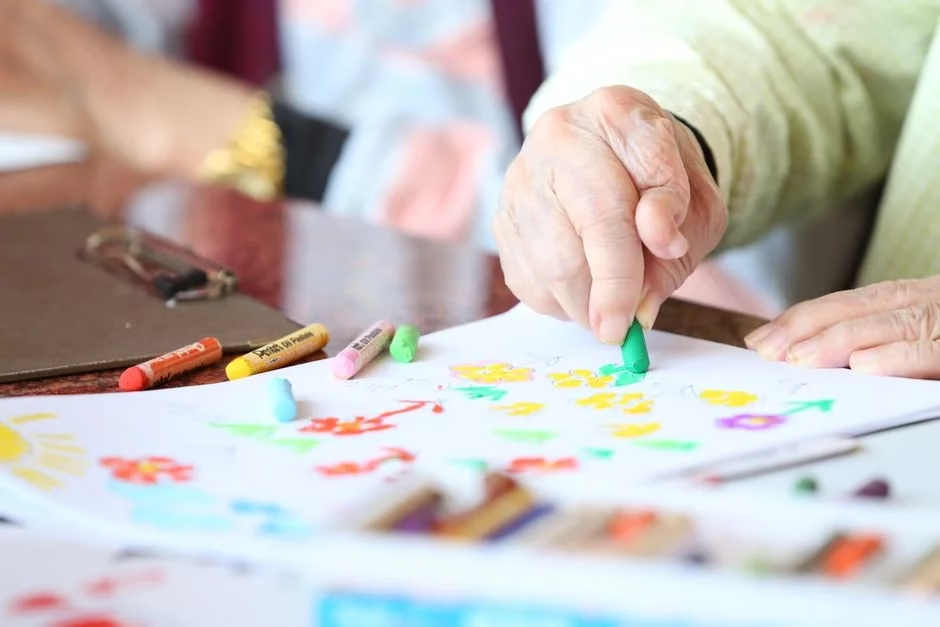
Imagine sitting in front of a blank piece of paper, no instructions, no grades, no one watching. You pick up a crayon — maybe red, maybe grey — and you just start moving it. Something shifts. Your shoulders drop. Your breathing slows. You didn’t say a single word, but somehow, something heavy just got a little lighter.
That quiet shift isn’t just in your head. It’s happening in your body, in your brain chemistry, in the actual wiring of your nervous system. Art therapy for mental health works not because of what you create, but because of what the process of creating does to you — and the science behind it is genuinely surprising.
This post will walk you through what art therapy really is, why it works even if you can’t draw a straight line, what the research actually shows about stress hormones and brain rewiring, and some simple ways you can try it today — no art degree required.
Relevant blog to read: How to Talk About Mental Health
Table of contents
It Has Nothing to Do With Being Artistic
This is probably the biggest thing that stops people from even trying art therapy. They think it’s for people who are good at art. It isn’t. Not even a little bit.
Art therapy is built on one core idea: everyone is capable of self-expression, and the act of making something — anything — can help you process emotions that words simply can’t reach. A trained art therapist isn’t looking at your painting and thinking “nice brushwork.” They’re sitting with you while you find a way to say something your mouth hasn’t been able to say yet.
Think about a time you felt something so big, so tangled, that when someone asked “how are you?” you just said “fine” — because where would you even start? That’s exactly the gap art therapy fills. It gives your feelings a shape, a colour, a place to exist outside of you.
- No skill needed: Scribbles, blobs, torn paper — all of it counts. The therapist is interested in what the process reveals, not whether the result is pretty.
- Non-verbal by design: Art therapy was specifically developed as a non-verbal pathway for people whose emotions are too overwhelming or too buried to speak out loud.
- Process over product: The goal is never a finished piece of art. It’s a finished feeling — one that’s been named, held, and made slightly more manageable.
So if you’ve ever written off art therapy because you “can’t draw,” consider this your permission to let that go. The crayon doesn’t care.
What’s Actually Happening in Your Brain and Body
Here’s the part that tends to make people stop and think. Art therapy isn’t just emotionally soothing — it creates measurable, physical changes in your body while you’re doing it.
When you’re stressed, your body produces cortisol. That’s the hormone that keeps you tense, alert, and wound up. Research published in the American Scientist found that people who worked with a trained art therapist had noticeably lower cortisol levels in their saliva after sessions, along with improved mood and a greater sense of self-efficacy — compared to people who made art entirely on their own. The therapist’s presence matters. The structure matters. But so does the act of creating itself.
Forty-five minutes. That’s roughly how long it takes for a creative session to shift your body’s stress response in a measurable way. Not weeks of practice. Not years of therapy. Forty-five minutes with some paint or clay or coloured pencils.
Beyond cortisol, something longer-lasting is also happening. The creative process helps rewire neural pathways — the brain’s established routes for processing experience and emotion. Trauma, anxiety, and depression can lock those pathways into painful loops. Art-making, especially with a therapist guiding the process, gently helps the brain build new routes. New ways of seeing. New ways of feeling through something rather than being stuck inside it. This is why art therapy for trauma and PTSD treatment has become a serious clinical tool, not just a gentle add-on.
The Numbers That Tell the Real Story
It’s easy to be sceptical of anything that sounds a bit alternative. So here’s what the data actually says — and some of it is remarkable.
- 73% reduction in anxiety, depression, and stress symptoms has been recorded in studies, particularly among children diagnosed with autism spectrum disorder. Creative art therapy for children with autism has shown consistent, replicable results across research settings.
- 79% of participants reported increased self-esteem and a more positive self-image following art therapy sessions — a figure that matters enormously when depression has been quietly dismantling someone’s sense of worth.
- 77% of people who completed art therapy reported improved overall psychological health, along with better communication and social skills. That’s significant for anyone who finds social connection difficult or draining.
- 34% reduction in pain and fatigue was recorded in cancer patients receiving art therapy — a reminder that the body and mind are not separate systems, and that emotional relief genuinely changes physical experience.
- 77% reduction in the use of physical restraint, seclusion, and sedative injections in psychiatric settings where art therapy was introduced. That one deserves a moment to sit with.
These aren’t small numbers. They’re the kind of numbers that suggest art therapy belongs in far more places than it currently lives.
How Art Therapy Helps With Emotional Regulation
You know that feeling when an emotion is so big it seems to take over your entire body? Your chest tightens, your thoughts spiral, and no amount of telling yourself to calm down actually works? That’s your nervous system running the show — and talking about it often makes it worse before it makes it better.
This is where how art therapy helps with emotional regulation becomes clearer. When you pick up a brush or squeeze clay or tear pictures from a magazine, your hands are busy. Your body is engaged in something tangible. That physical engagement gently pulls your nervous system out of pure fight-or-flight mode and into something more regulated — what researchers call a state of “active calm.”
The emotions don’t disappear. They land somewhere. They take a form on the page or in the clay. And once something has a form, it’s a little less frightening. You can look at it. You can decide what to do with it. That’s regulation — not suppression.
For Trauma, Specifically
One of the most powerful art therapy benefits for anxiety and depression rooted in trauma is this: you don’t have to tell the story out loud. Traditional talk therapy asks you to find words for the thing that broke you — to sit across from someone and narrate your worst moments on demand. Sometimes that works. Sometimes it just opens the wound again. Art therapy offers a different route. You can express what happened through colour, shape, or image — at whatever distance feels safe — without ever having to find the words. The nervous system gets to process without being flooded.
Simple Ways to Bring This Into Your Life Today
You don’t need a therapist’s office, a set of professional paints, or a free afternoon. You need about fifteen minutes and a willingness to feel a little silly at first.
- Emotion painting: Pick a colour that matches how you feel right now — not how you think you should feel. Put it on paper however you like. Add another colour if needed. Don’t plan it. Don’t judge it. Just let it happen for ten minutes.
- The feelings collage: Flick through an old magazine and tear out any images or colours that feel like your current emotional state. Arrange them on a page. You don’t need to explain it to anyone. Just notice what you chose.
- Daily sketching without stakes: Spend fifteen minutes drawing something simple — your coffee mug, your hand, something outside the window. The subject doesn’t matter. The quiet focus does.
- Clay or playdough: If you’re carrying physical tension, working something with your hands — squeezing, shaping, pressing — engages your tactile senses and releases stress through the body, not just the mind.
- The weekly art date: Set aside one hour a week that belongs entirely to making something. Not when you feel inspired. Not when things are bad enough to justify it. Every week, like clockwork — because you don’t wait until you’re starving to eat.
After you create something, even something small, try writing three sentences about it. Not an art critique — just what you notice. What colours felt right. What it was like to make it. That reflection is where a lot of the processing happens.
You don’t have to be going through something major to benefit from this. A Tuesday that felt too long. A week that left you numb. A feeling you can’t name. These are all enough reason to pick up a crayon and see what happens.
Frequently Asked Questions
Art therapy gives anxiety and depression somewhere to go. When emotions are too tangled or painful to put into words, the creative process offers a non-verbal route — letting you express feelings through colour, shape, or image instead. Research shows it can reduce symptoms of anxiety, depression, and stress by 73%, while also lowering cortisol levels, which is the hormone your body produces when you're under stress.
Not at all — and this is the most common misconception about art therapy. The whole point is the process, not the product. A trained art therapist isn't evaluating your artwork; they're helping you use the act of creating as a way to access and process emotions. Scribbles, blobs, and torn magazine pages all work just as well as anything technically skilled.
Yes, and the evidence is measurable. Research highlighted in the American Scientist found that people who took part in guided art therapy sessions had lower cortisol levels in their saliva afterwards, along with better mood and a stronger sense of self-efficacy. Cortisol is your body's main stress hormone, so lower levels mean your nervous system is genuinely calming down — not just feeling calmer.
Creative art therapy has shown particularly strong results for children with autism spectrum disorder. Studies have recorded a 73% reduction in anxiety, depression, and stress symptoms in this group, alongside improved communication and social skills in 77% of participants. Because art therapy is non-verbal by nature, it offers children who struggle with spoken communication a powerful alternative way to express themselves and connect with others.
Some effects happen faster than you might expect. Research shows that a single 45-minute session can produce measurable changes in stress hormone levels and mood. Deeper shifts — like improved emotional regulation, stronger self-esteem, or reduced trauma symptoms — typically develop over several weeks of regular sessions. Even simple daily creative practices at home, like ten minutes of free drawing, can start building those benefits gradually.
Related Reading
- How to Talk About Mental Health
- How Does Social Media Affect Mental Health
- New Years Mental Health Goals to Actually Keep in
- Mental Health Awareness From Knowing to Actually Helping
Author’s note
Thank you for taking the time to focus on your well-being and for being your own cheerleader in this journey called life. I truly appreciate you for choosing to invest in yourself today, and I’m honored that you spent a part of your day here. Remember, every small step you take matters, and you’re doing an amazing job. Keep going—you’ve got this!