You’ve probably tried to meditate before. Maybe you sat on the floor, tried to clear your mind, lasted about ninety seconds before your brain started writing a grocery list, and quietly gave up. That’s not a failure of willpower. That’s just what happens when a technique asks too much of a mind that’s already running on empty.
Transcendental Meditation benefits have been talked about for decades, but the part nobody really explains is why so many people actually keep doing it — when most meditation habits quietly fade after a week or two. The answer turns out to be surprisingly simple, and it has nothing to do with being naturally zen.
This post covers what Transcendental Meditation actually is, why it works differently from other meditation styles, what the research genuinely says about stress and sleep, and how to build the habit starting today — no crossed legs or emptied minds required.
Relevant blog to read: Meditation for Stress Relief Rewires Brain
Table of contents
- The Real Reason Most Meditation Habits Don't Last
- What Transcendental Meditation Benefits Does the Research Actually Show?
- Two Common Misconceptions Worth Clearing Up
- How to Do Transcendental Meditation: A Simple Starting Point
- One Important Thing to Keep in Mind
- Frequently Asked Questions
- Related Reading
- Author's note
The Real Reason Most Meditation Habits Don’t Last
Here’s the thing about stress: it doesn’t just make you feel awful — it quietly drains the mental resources you need to do anything effortful. That includes most meditation techniques, which ask you to focus your breath, observe your thoughts without reacting, or hold your attention on a single point. Those are real skills. They take practice. And when you’re burnt out and anxious, practising a skill feels like one more thing to get wrong.
That’s the gap Transcendental Meditation fills. Unlike focused-attention or mindfulness-style practices, TM is described as an effortless technique. You’re not trying to concentrate. You’re not monitoring your thoughts. You sit comfortably, close your eyes, and gently repeat a mantra — a simple sound — in your mind. When your attention wanders (and it will), you just drift back to the mantra without judgment. No technique to perfect. No wrong way to do it.
Mental health clinicians who recommend TM often point to exactly this quality: its low-friction structure. A practice you can actually repeat daily, even on your worst days, tends to serve you better than a theoretically superior one you never get around to doing. That’s not a small thing — that’s the whole game when it comes to building habits that actually change how you feel.
What Transcendental Meditation Benefits Does the Research Actually Show?
Let’s be honest about what the evidence says — and what it doesn’t. TM has been studied for several decades, and the findings are genuinely encouraging in some areas. But it’s not magic, and it’s not for everyone in every situation. Here’s a grounded look at where the research points.
- Stress and anxiety: Cleveland Clinic lists TM as a practice that may help reduce stress, anxiety, and depressive symptoms. The mechanism makes sense — when your nervous system gets a genuine rest twice a day, it has less time stuck in high-alert mode.
- Sleep: Many people report that practising transcendental meditation for sleep helps them fall asleep more easily. When your stress levels drop through the day, your body finds it easier to wind down at night.
- Heart health: A 2022 review published in PMC found substantial evidence linking TM to reduced cardiovascular risk factors and lower rates of cardiovascular disease — suggesting its stress-regulating effects may reach well beyond the mind.
- Focus and memory: Cleveland Clinic also notes potential improvements in focus and mental clarity, which makes sense when you consider that a calmer, less overloaded brain simply works better.
- Self-esteem and mood: Some clinical summaries point to improvements in self-esteem and overall mood over time, particularly when TM is practised consistently at the recommended dose.
The honest caveat is this: some reviews argue that TM doesn’t always outperform other relaxation approaches when they’re studied head-to-head. So it’s worth keeping expectations realistic. TM isn’t a cure. It’s a consistent, gentle input that helps your nervous system recover — and over weeks and months, that recovery adds up.
Two Common Misconceptions Worth Clearing Up
Before you try transcendental meditation for anxiety or stress, two ideas are worth letting go of — because they’ll trip you up if you hold onto them.
Misconception 1: TM is just another word for mindfulness
Mindfulness meditation usually asks you to observe what’s happening in your mind and body right now — your breath, your sensations, your thoughts passing through. It’s an active, attentive practice. TM is different. There’s no observing or monitoring. You’re simply repeating a mantra and allowing the mind to settle on its own. The goal isn’t awareness — it’s a state of restful alertness, almost like the mental equivalent of a deep nap while still being gently awake.
Misconception 2: You have to empty your mind
This one stops a lot of people before they even start. The instructions for TM are actually the opposite of thought suppression. Thoughts will come — that’s normal, that’s human. The practice is simply to notice when your attention has drifted and return to the mantra gently, without frustration. Think of it less like clearing a room and more like coming home to a quiet place every time you wander off.
How to Do Transcendental Meditation: A Simple Starting Point
Traditional TM is taught through a certified instructor who gives you a personalised mantra. But you can begin exploring the structure and rhythm of the practice on your own right now. Here’s how the basics work.
- Choose your times: Practising transcendental meditation twice a day works best when you anchor it to existing routines — once in the morning before the day gets loud, and once in the late afternoon or early evening before dinner. Attaching the habit to something you already do makes it automatic.
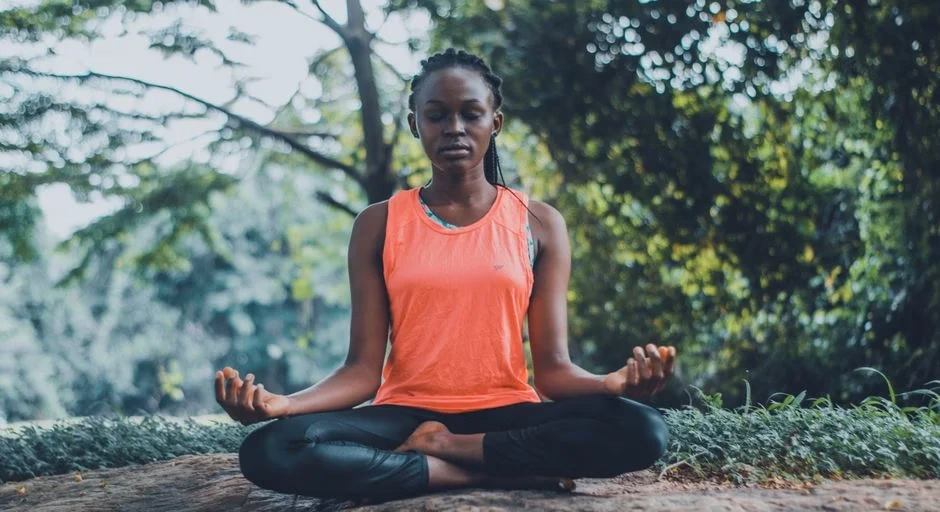
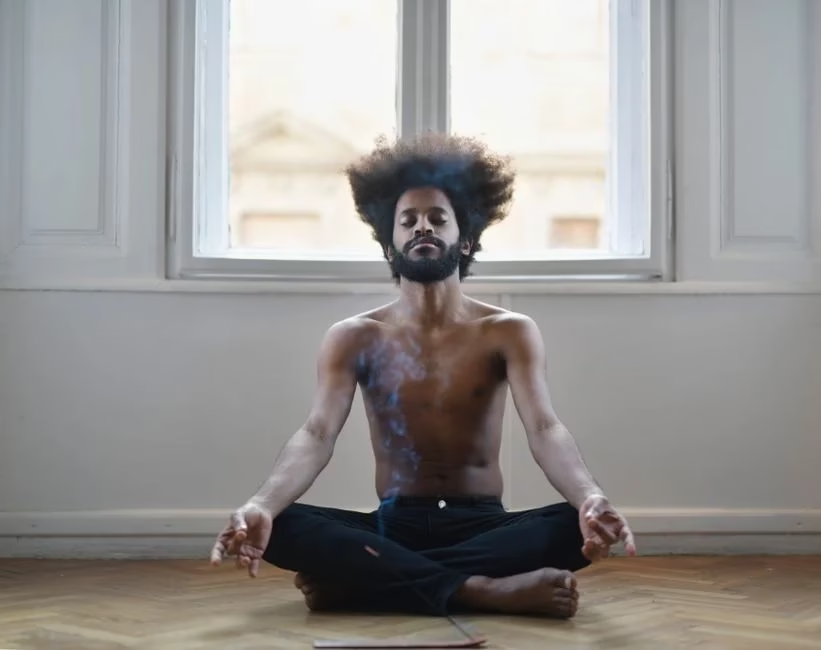
- Find a comfortable seat: You don’t need a meditation cushion or a special room. A chair works perfectly. Sit upright but without strain, close your eyes, and let your hands rest easily.
- Take a brief transition: A few slow, easy breaths before you start helps your mind shift gears from whatever you were just doing. It’s a small step, but it makes settling in noticeably easier.
- Begin the mantra: Silently repeat your chosen sound or word in your mind — not loudly, not with force, just a gentle mental whisper. You’re not trying to focus intensely. You’re just giving the mind something soft to return to.
- Return without judgment: When your mind wanders — and it will, every single session — simply notice it and ease back to the mantra. That moment of return is not a failure. It is the practice.
- Sit for 15–20 minutes: Set a gentle timer if you need to. Over time, you’ll develop a natural sense of when the session is ending.
- Come back slowly: Don’t reach for your phone the second you open your eyes. That first minute of quiet — just sitting, blinking slowly back into the room — is often when you notice the shift most clearly. Don’t skip it.
One practical suggestion: track how you actually feel, not whether you meditated perfectly. Three words in your notes app — wired, okay, surprisingly calm — is enough. After two or three weeks, you’ll have evidence you can see, which matters more than motivation on the nights you’d rather just scroll.
One Important Thing to Keep in Mind
TM is not a substitute for help when you genuinely need it. If you’re managing anxiety, depression, PTSD, or something physical like high blood pressure, keep TM alongside whatever treatment or therapy is already in place — not instead of it. It’s not a fix. It’s more like sleep: not glamorous, not dramatic, but your whole system quietly works better when you’re getting enough of it.
What it can do — slowly, without announcing itself — is give your nervous system two real breaks a day. In a life that never quite stops asking things of you, that turns out to be worth more than it sounds.
Frequently Asked Questions
Transcendental Meditation is a simple mantra-based practice where you sit comfortably with your eyes closed and silently repeat a sound or word in your mind for 15–20 minutes. You're not trying to focus hard or clear your thoughts — just gently returning to the mantra whenever your mind wanders. It's typically practised twice a day, once in the morning and once in the afternoon or evening.
Many people find that practising TM regularly helps reduce the background hum of anxiety over time. Cleveland Clinic notes it may help with anxiety, stress, and depressive symptoms. The likely reason is that giving your nervous system a genuine, effortless rest twice a day gradually lowers your overall stress baseline — making anxious thoughts feel less overwhelming across the day.
The standard recommendation is 15–20 minutes per session, twice a day. Morning and late afternoon tend to work best for most people. You don't need to start at the full 15 minutes — even shorter sessions can help you build the habit first, and you can gradually extend as it becomes part of your routine.
It can, for many people. When regular TM practice helps reduce daytime stress and anxiety, the body finds it easier to wind down at night. You're not doing TM at bedtime — you're doing it earlier in the day to lower your overall stress load, which naturally supports better sleep. A 2022 PMC review also linked TM to broader physiological stress regulation.
Yes, they're genuinely different approaches. Mindfulness typically asks you to actively observe your thoughts, breath, or sensations in the present moment. TM asks for none of that — you simply repeat a mantra effortlessly and let the mind settle on its own. There's no monitoring, no concentrating. Many people who find mindfulness difficult discover TM feels much more accessible to practise daily.
Related Reading
- Meditation for Stress Relief Rewires Brain
- Stress Resilience Strategies That Actually Work
- Stress Management Techniques That Actually Work
- Positive Affirmations That Actually Work
Author’s note
Thank you for taking the time to focus on your well-being and for being your own cheerleader in this journey called life. I truly appreciate you for choosing to invest in yourself today, and I’m honored that you spent a part of your day here. Remember, every small step you take matters, and you’re doing an amazing job. Keep going—you’ve got this!