

You know that feeling when you’re sitting in a traffic jam, your to-do list is three pages long, and someone asks how you are — and you just say “fine” because the truth is too complicated to explain? That hollow, slightly frantic feeling underneath ordinary life. That’s the opposite of inner peace. And if you’ve ever assumed inner peace is something only monks or people on year-long sabbaticals get to feel, this post is going to change your mind.
Inner peace techniques are learnable, and inner peace isn’t a distant destination or a personality trait some people are born with. It’s a skill. A learnable, practicable, everyday skill — and the research backs that up completely. The inner peace techniques in this post are grounded in real science and designed to fit into a real life, not an idealised one.
By the time you reach the end, you’ll have a handful of genuinely useful tools you can start using today — even on the hard days.
Relevant blog to read: Questions to Get to Know Someone
Table of contents
The Biggest Myth About Inner Peace (And Why It Matters)
Most people picture inner peace as a permanent, unshakeable calm — a life where nothing rattles you, stress slides off like water, and you float through the day smiling serenely. That’s not inner peace. That’s emotional numbness, and it’s not something to aim for.
Real inner peace is something quite different. Experts describe it as psychological homeostasis — your mind’s ability to find its balance again, even in the middle of conflict or difficulty. It’s not that the storm disappears. It’s that you don’t get completely swept away by it.
Think of it like a gyroscope. A gyroscope spins, tilts, gets knocked about — and then finds its centre again. That’s what inner peace actually feels like. Not the absence of hard feelings, but the ability to return to yourself after them.
This matters because if you’ve been waiting to feel peaceful only once everything settles down — the job stress, the relationship tension, the money worries — you could be waiting a very long time. Inner peace lives inside the chaos, not after it.
Why Your Mind Struggles to Feel Peaceful (It’s Not Your Fault)
Before jumping into what to do, it helps to understand why peace feels so hard to hold onto in the first place.
Your brain is wired to scan for threats. It was genuinely useful thousands of years ago when threats were physical and immediate. These days, your brain treats an unanswered email or a difficult conversation with the same urgency it once reserved for predators. The result is a nervous system that’s quietly on high alert for much of the day, even when nothing is actually wrong.
When stress keeps that alarm system running for too long, your breathing gets shallow, your thoughts race, and calm starts to feel impossibly far away. The good news is that the brain is remarkably changeable. The practices below work because they directly interrupt that alarm response — gently, repeatedly, and over time, more permanently.
Inner Peace Techniques You Can Start Using Today
These aren’t abstract ideas. Each one has a clear reason it works, and a simple way to try it — starting right now if you want.
Mindfulness: Giving Your Brain a Rest from Its Own Noise
Mindfulness gets talked about so much that it can start to feel like another thing you’re failing at. But at its core, it’s incredibly simple: you pay attention to what’s happening right now, without judging it. That’s it.
When your mind is constantly replaying the past or rehearsing the future, it never gets a genuine break. Mindfulness interrupts that cycle. It teaches the brain to observe thoughts without being hijacked by them — which, over time, lowers anxiety and creates more space for calm.
A 2023 study from Psychology Today found that 70% of adults reported higher inner peace levels after practising daily mindfulness meditation. That’s not a small number. And the practice itself doesn’t have to be complicated.
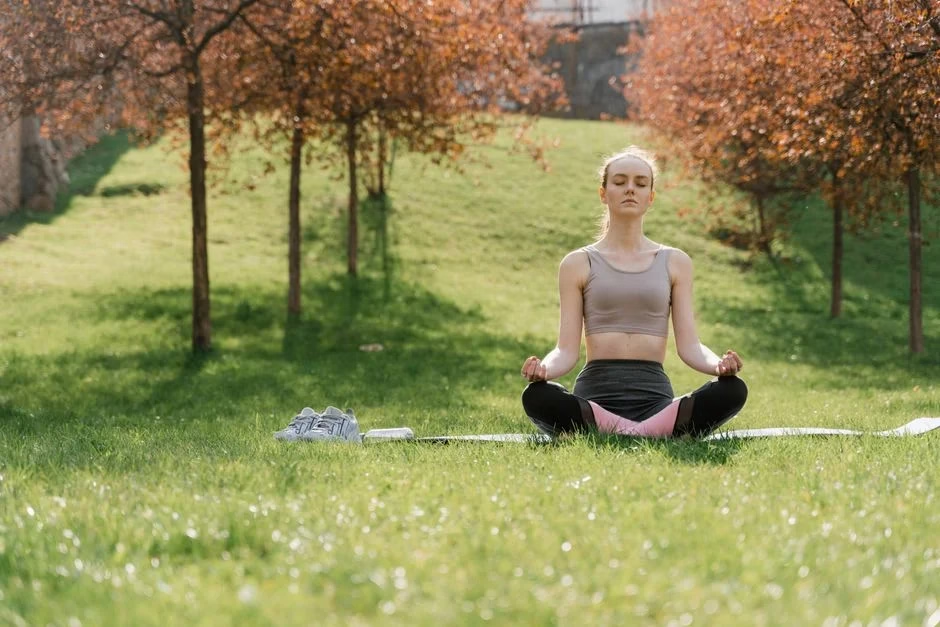
- Try this today: Set a timer for ten minutes each morning. Sit somewhere quiet, close your eyes, and just notice your breath moving in and out. When your mind wanders — and it will — gently bring it back. No frustration needed. The wandering and returning is the practice.
Gratitude: The Fastest Way to Shift What You’re Focusing On
When life feels heavy, the mind has a habit of cataloguing everything that’s wrong. It’s not pessimism — it’s just how brains conserve energy by spotting problems. But it means that what’s actually good, steady, and working can become invisible.
A gratitude practice works by gently redirecting your attention. Not in a forced, toxic-positivity kind of way — but in a way that honestly reminds your nervous system that not everything is falling apart. Research by Liang and colleagues in 2020 found that people who kept a gratitude journal reported 40% more peace of mind than those who didn’t. That’s a meaningful difference from something that takes five minutes.
- Try this tonight: Before you go to sleep, write down three specific things you’re grateful for. Not vague things like “my health” — specific ones, like “the cup of tea I had this afternoon” or “the fact that my friend texted to check on me.” Specificity is where the shift happens.
Nature: The Simplest Reset Button You Have Access To
You don’t need a forest or a mountain. A park, a garden, even sitting near a window with a view of the sky works. Spending time outdoors — properly outdoors, not just walking to your car — has a measurable calming effect on the nervous system.
Nature pulls your attention outward, away from the looping internal monologue. The sounds, textures, and rhythms of the natural world engage a different kind of awareness — one that’s slower, softer, and genuinely restorative. Studies on gardening found that people who garden regularly score 25% higher on inner peace measures than those who don’t. Something about getting your hands in soil, or simply being near growing things, quiets the mental noise.
- Try this this week: Spend twenty minutes outside each day — without your phone if you can manage it. Walk slowly. Notice what you can hear, smell, and see. Let your pace match the world around you rather than the world inside your head.
Stillness and Silence: Reconnecting with What’s Actually There
Most people fill every quiet moment — queuing, eating, waiting — with their phone, music, or noise. It’s not a character flaw. Silence can feel uncomfortably loud when your head is already full. But all that constant input means your real thoughts never quite get a hearing — so they show up at 2am instead, when there’s nowhere left to hide from them.
A simple way to use stillness is to ask yourself one honest question each day: What most wants my attention right now? Not to fix it immediately, but just to notice it with kindness. That small act of turning toward yourself — rather than away — builds inner trust over time.
- Try this: Create a “joy list” — a short, personal list of things that bring you genuine calm or happiness. Review it when you feel overwhelmed. Then choose one thing from it and actually do it. The list is only useful if it moves you toward action.
Decluttering: The Surprising Link Between Your Space and Your Mind
Cluttered spaces do something subtle but real — they create a constant low-level visual noise that keeps your brain in mild problem-solving mode. You’re not consciously stressed by the pile of papers on the desk, but your brain is quietly registering it as unfinished business.
Tidying isn’t a personality trait or a lifestyle brand. It’s a practical way to reduce one source of unnecessary mental load. And you don’t need to overhaul your entire home at once.
- Try this: Pick one drawer or one small space each week and clear it out. Notice how it feels when you open it afterwards. That small, visible sense of order is something your nervous system genuinely responds to.
How Long Does It Actually Take to Feel the Difference?
Honestly? It varies — and anyone who gives you a specific number is probably selling something. What the research does show is that consistent, daily practice — even just ten to twenty minutes — creates measurable shifts within weeks, not years. Inner peace isn’t a switch that flips. It’s more like a muscle you’ve been ignoring: tender at first, then gradually stronger.
Some days you’ll practise all of this and still feel wobbly. That’s completely normal and doesn’t mean you’re doing it wrong. The goal isn’t to feel peaceful every single moment. It’s to spend a little less time swept away, and a little more time finding your way back. That’s enough. That’s actually a lot.
How to Protect Your Inner Peace When Life Gets Loud
Building calm is one thing; protecting it when a deadline lands or a difficult conversation flares up is another. The most reliable inner peace techniques include a few simple guardrails for the moments life gets genuinely loud.
- Create a pause before you react. One slow breath between a trigger and your response is often enough to keep a small stress from becoming a big one.
- Protect your inputs. Endless notifications and doom-scrolling quietly erode calm. A few phone-free pockets in your day do more than any single relaxation trick.
- Have a go-to reset. When stress spikes, lean on a practice you already trust — the kind of practical, evidence-based tools in these stress management techniques that actually work.
Inner peace was never meant to be a fragile, perfect stillness. It’s a steadiness you can return to — again and again — no matter how loud the day becomes.
Frequently Asked Questions
Start with your breath — not because it's a cliché, but because stress physically tightens your breathing, and slowing it down sends a direct signal to your nervous system that you're safe. Try breathing in for four counts, holding for four, and out for four. Do it three times. Then choose one small thing from this post — a short walk, writing down three things you're grateful for — and do just that one thing today.
Yes, absolutely. Meditation is one route, but it's not the only one. Spending time in nature, keeping a gratitude journal, decluttering a small space, or simply sitting quietly for a few minutes each day can all build genuine inner calm. Research shows that gardeners, for example, score significantly higher on inner peace measures than non-gardeners — no formal meditation required.
Most people notice small but real shifts within a few weeks of consistent daily practice — even just ten to fifteen minutes a day. It won't be a dramatic transformation overnight, and some days will still feel hard. But inner peace builds gradually, the way a muscle strengthens over time. The key is consistency over intensity — showing up daily matters more than doing any one thing perfectly.
Because your brain is wired to stay alert to problems — it's an ancient survival instinct that doesn't always know when to switch off. Modern life keeps that alarm system busy, which means calm can feel like a temporary visitor rather than a permanent resident. That's not a personal failing. It just means peace needs to be practised, not waited for.
The gratitude journal is one of the most accessible starting points — it takes five minutes before bed and requires nothing but a notebook. Write down three specific things that went okay today. Research by Liang and colleagues found that people who do this consistently report significantly more peace of mind than those who don't. Specific beats vague every time, so skip generalities and write what actually happened.
Author’s note
Thank you for taking the time to focus on your well-being and for being your own cheerleader in this journey called life. I truly appreciate you for choosing to invest in yourself today, and I’m honored that you spent a part of your day here. Remember, every small step you take matters, and you’re doing an amazing job. Keep going—you’ve got this!




2 Comments