


You have the career, the relationships, the home—the life society deems “successful.” Yet, in quiet moments, a gnawing Feeling of Emptiness persists. It’s a paradox: having everything on paper but feeling profoundly disconnected from your own life.
This is not a failure of character; it’s a profound signal that your emotional and mental health needs are not being met by external achievement. Understanding this phenomenon is the first step toward building a truly fulfilled life.
Relevant blog to read: Declutter Your Mind, Organize Your Year: A Bullet Journal Starter Guide for 2026 Productivity
The Psychological Roots of the “Feeling of Emptiness”
If the problem isn’t external, it must be internal. Psychology and mental health experts point to several key factors that drive the Feeling of Emptiness in seemingly happy lives.
1. The Hedonic Treadmill (The Pursuit of Pleasure)
The Hedonic Treadmill is a psychological phenomenon where humans constantly return to a baseline level of happiness, regardless of major positive or negative events. That new car, promotion, or vacation provides a temporary spike of pleasure (a “hit”), but our emotional system quickly adapts, making the “new normal” feel ordinary again.
We mistake pleasure (short-term, sensory satisfaction) for fulfillment (long-term, deep-seated satisfaction derived from meaning). When we base our life on chasing the next temporary pleasure, we inevitably end up back at baseline, staring at the Feeling of Emptiness.
2. Emotional Suppression and Disconnection
Many successful individuals learn early on to suppress complex or “negative” emotions (fear, sadness, inadequacy) to maintain high performance. While this is effective for professional goals, it has a severe psychological cost.
- Emotional Numbing: When you selectively turn off “bad” feelings, you also dull your ability to feel the “good” ones, leading to emotional flatness.
- False Self: We build a carefully curated “successful” persona that doesn’t align with our authentic self. This gap between who you are and who you feel you must be is a major source of internal disconnection and the Feeling of Emptiness.
3. The Crisis of Meaning and Value Misalignment
At its core, the Feeling of Emptiness is often a crisis of meaning. Modern life provides paths to success but often fails to provide a framework for purpose.
- Goal Orientation vs. Value Orientation: We focus heavily on goals (achieve X, buy Y) rather than values (living with integrity, creativity, connection). When you achieve a goal, it’s fleeting; when you live according to a core value, the fulfillment is constant.
- The “Shoulds” vs. the “Wants”: The emptiness arises when you realize you’ve been building a life based on what others or society told you “should” make you happy, rather than what genuinely aligns with your deepest desires.
Practices to Cultivate True Fulfillment
Shifting from the Feeling of Emptiness to fulfillment requires turning your focus inward and intentionally restructuring your emotional architecture.
1. Identify Your Core Values (The Compass)
Stop asking, “What should I do?” and start asking, “How do I want to be?”
- The Exercise: List 5-10 core values (e.g., integrity, curiosity, community, mastery, simplicity). Then, audit your last week. How many hours did you spend actively engaging in activities aligned with those values? When your time and energy align with your values, fulfillment naturally follows.
2. Seek Flow States (The Engine)
The psychologist Mihaly Csikszentmihalyi defined Flow as the state of being completely absorbed in an activity that is optimally challenging, leading to intense enjoyment and a loss of self-consciousness.
- Actionable Step: Find activities that demand your full, undivided attention, matching your skills to the difficulty. This could be playing a musical instrument, coding, woodworking, painting, or competitive sport. Flow is the opposite of emptiness—it provides intrinsic satisfaction that pleasure cannot replicate.
3. Mindful Re-engagement with Emotion
To feel full, you must learn to feel everything.
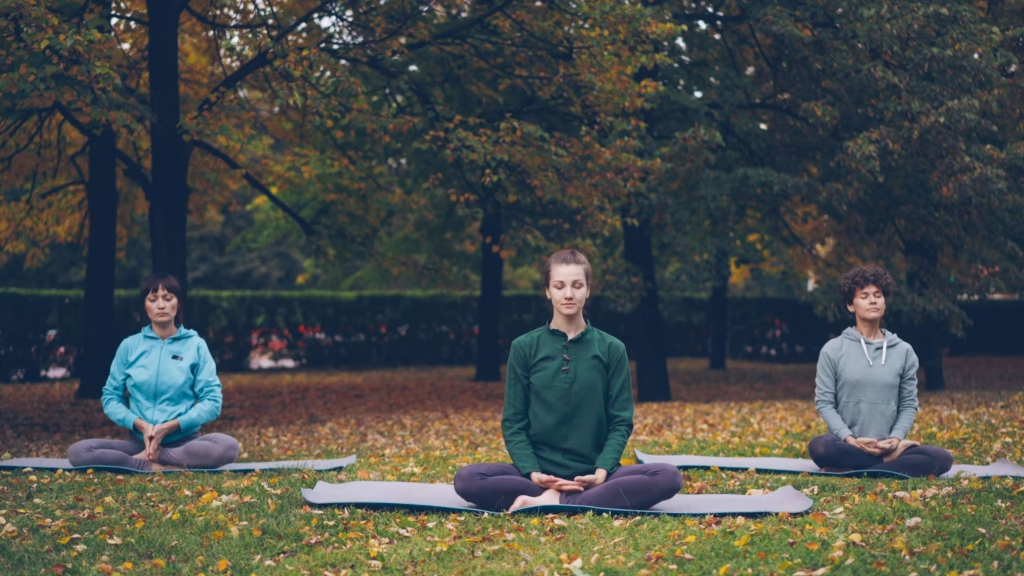
- Practice Mindfulness: Use daily mindfulness meditation to observe your emotions without judgment. When you feel anxiety, acknowledge it as a temporary state, rather than suppressing it or letting it define you. This practice rebuilds your emotional tolerance.
- Name It to Tame It: Practice identifying and naming complex feelings (e.g., “This isn’t just ‘stress,’ it’s ‘fear of failure’ mixed with ‘tiredness'”). This helps integrate the emotion rather than pushing it away.
4. Cultivate Meaning through Contribution
Purpose often comes from externalizing your focus—contributing something of value beyond your own needs.
- Mentorship or Volunteering: Engaging in an activity that helps others or supports a cause you believe in re-frames your skills from a source of personal gain to a source of shared value. This connection to something larger than yourself is a powerful antidote to the Feeling of Emptiness.
Frequently Asked Questions (FAQs)
A: It can be. While persistent emptiness can stem from a lack of meaning, it is also a common symptom of clinical depression or persistent depressive disorder (dysthymia). If the feeling is severe, lasts for more than two weeks, and is accompanied by fatigue, hopelessness, or changes in appetite/sleep, seeking consultation with a mental health professional is strongly recommended.
A: A vacation or a move can provide a temporary escape, but the Feeling of Emptiness is internal. It’s often summarized by the saying, “Wherever you go, there you are.” While new scenery can create space for reflection, the core work of identifying values and seeking meaning must happen internally.
A: The fastest way to start is by consciously seeking a Flow State. Engage in a challenging, skill-based activity that requires intense concentration for at least 30 minutes. Breaking the routine of passive consumption (like scrolling) and replacing it with active creation or engagement is the most immediate way to counteract emotional flatness.
Author’s note
Thank you for taking the time to focus on your well-being and for being your own cheerleader in this journey called life. I truly appreciate you for choosing to invest in yourself today, and I’m honored that you spent a part of your day here. Remember, every small step you take matters, and you’re doing an amazing job. Keep going—you’ve got this!


One Comment