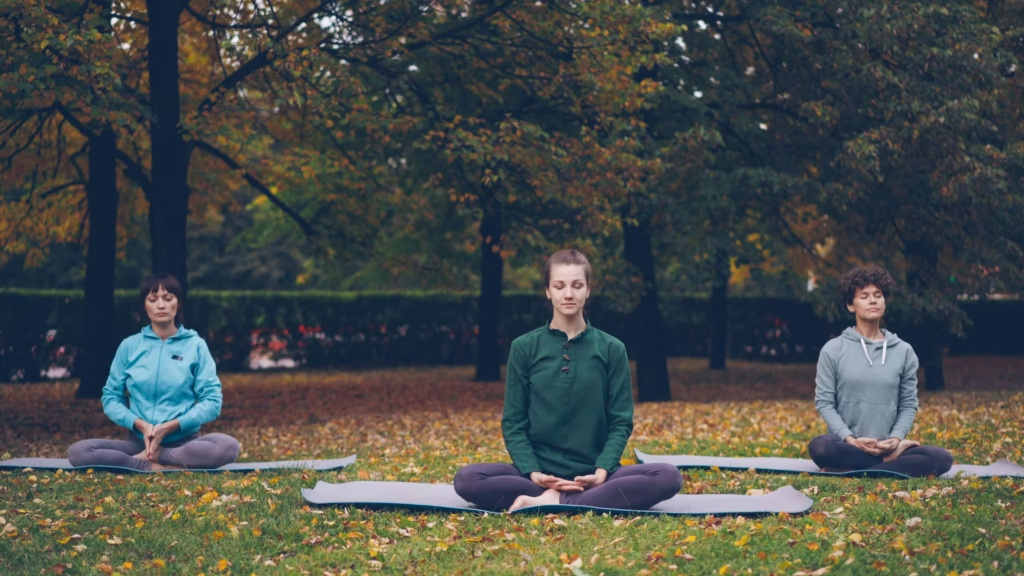
The October Theory is a viral psychological concept that reframes October as the “Second New Year.” It suggests that October, rather than January, is the most effective time for a life reset, goal setting, and emotional recalibration.
While it originated as a TikTok trend, it is deeply rooted in the “Fresh Start Effect”—the psychological phenomenon where natural transition points (like a new season) boost our motivation to change.
Relevant blog to read: How Music Affects Mental and Emotional Health: The Science of Sound
October Theory: Why the “Second New Year” is Better for Your Mental Health
Forget January 1st. According to the October Theory, the real window for transformation begins when the leaves start to turn. This viral movement suggests that October is the ultimate “second chance” to align your life before the year ends, offering a low-pressure alternative to the often-disappointing New Year’s resolutions.
What is the October Theory?
The theory posits that October functions as a natural checkpoint. By the time October 1st hits, the “chaos” of summer has faded, the “back-to-school” energy has settled into a routine, and there are exactly 90 days left in the year.
Psychologically, this creates a “90-Day Sprint” mindset—a period long enough to see real results but short enough to maintain high urgency and focus.
Why October is Better Than January
1. The “Fresh Start Effect” Without the Pressure
In January, the world demands a “New Me.” In October, the world invites a “Refined Me.” Research on the Fresh Start Effect shows that we are more likely to succeed when we tie goals to temporal landmarks. October provides this landmark without the crushing weight of global expectation and “resolution guilt.”
2. Nature’s Lesson in “Letting Go”
October is the season of shedding. Just as trees drop their leaves to survive the winter, the October Theory encourages an “Emotional Audit.” It’s a time to ask: What habits, relationships, or mindsets am I carrying that are no longer serving my growth?
3. Building Momentum for the Holidays
The holiday season (November and December) is notoriously stressful. Starting a wellness routine in October allows you to build a “resilience buffer.” By the time the holiday rush arrives, your new habits (like meditation, walking, or journaling) are already locked in.
How to Apply the October Theory to Your Wellbeing
1. Conduct an “Emotional Audit”
Take 15 minutes to journal about your year so far. Identify one thing that drains your energy and one thing that fuels it. Commit to “dropping” the drainer by October 31st.
2. Use “Habit Stacking”
Don’t overhaul your life. Use the cozy nature of the season to stack habits.
- Example: “While my morning tea/coffee brews, I will write three things I’m grateful for.”
3. The “Winter Arc” Focus
The “Winter Arc” is a sub-trend of the October Theory. It involves using the darker, colder months to “go ghost” on distractions and focus intensely on one personal project or health goal.
Frequently Asked Questions (FAQs)
A. It is a pop-psychology concept popularized on social media. However, it is based on the scientifically recognized “Fresh Start Effect” and seasonal behavioral shifts that psychologists have studied for decades.
A. While “Cuffing Season” (the desire to find a partner for the colder months) often happens in October, the October Theory is broader. it focuses on self-improvement, career, and mental health, not just romantic relationships.
A. It can. By reframing the shorter days as a “cozy reset” and a time for “intentional growth,” individuals can sometimes mitigate the “gloom” associated with autumn. However, it is not a replacement for medical treatment for SAD.
A. The beauty of the theory is that it’s about alignment, not a start date. Any day in the final quarter of the year is a better “New Year” than waiting for the arbitrary date of January 1st.
Author’s note
Thank you for taking the time to focus on your well-being and for being your own cheerleader in this journey called life. I truly appreciate you for choosing to invest in yourself today, and I’m honored that you spent a part of your day here. Remember, every small step you take matters, and you’re doing an amazing job. Keep going—you’ve got this!