

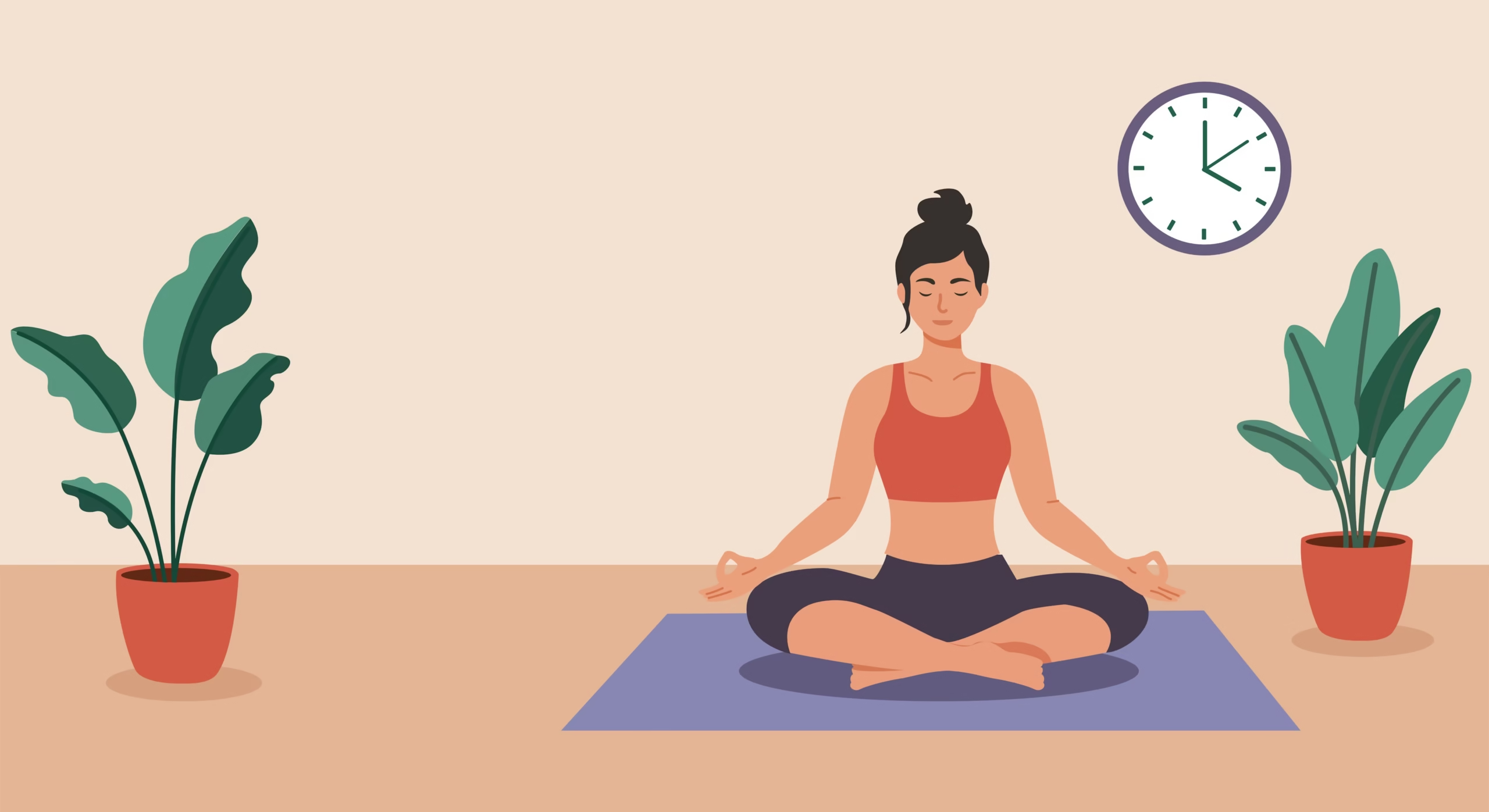
In the year 2026, the primary threat to our wellbeing isn’t just “stress”—it’s Acceleration Stress. This is the specific physiological and psychological friction caused by a profound biological mismatch: our ancient, slow-evolving nervous systems are trying to keep pace with a high-frequency, AI-accelerated digital world.
While the world moves in milliseconds, our biology still operates on the rhythms of the sun and the seasons. When we try to match the speed of our notifications, we enter a state of “High-Frequency Living” that leaves us wired, tired, and emotionally fragmented. To thrive, we must learn to “Downshift.”
Relevant blog to read: Vagus Nerve Stimulation: The Biological “Off-Switch” for Stress and Anxiety
What is Acceleration Stress?
Acceleration Stress occurs when the frequency of external stimuli (emails, pings, market shifts, AI updates) exceeds our brain’s capacity to process them emotionally. It keeps the amygdala in a state of perpetual “yellow alert,” never allowing the body to return to a true baseline of rest.
If you feel like life is moving faster than you can handle, you aren’t failing—you are simply experiencing a biological lag. Here is how to bridge that gap.
3 Deterministic Ways to “Downshift” Your Nervous System
To manage high-frequency living, we need tools that work at the speed of biology.
1. Vagus Nerve Stimulation: The Physiological Brake
The Vagus nerve is the commander of your parasympathetic nervous system. Think of it as the “manual override” for your stress response. By stimulating this nerve, you send a deterministic signal to your brain that it is safe to slow down.
- The “Salamander” Reset: Without moving your head, look as far as you can to the right for 30 seconds, then the left. This eye movement resets the suboccipital muscles, which are directly tied to the Vagus nerve.
- Cold Exposure: A splash of ice-cold water on the face for 10 seconds triggers the “Diving Reflex,” instantly lowering your heart rate (HRV).
- Humming/Gargling: The Vagus nerve passes through the vocal cords. Vigorous humming or gargling creates vibrations that stimulate the nerve directly.
2. The “April Theory” of Resets
As we move into 2026, the April Theory has become a cornerstone of seasonal wellness. It posits that the “New Year” should be treated as a biological event, not a calendar one.
- The Science: In the Northern Hemisphere, April brings increased sunlight and a surge in serotonin production. This is the natural “downshift” from winter’s internal focus to spring’s external growth.
- The Practice: Use April as your true “Annual Reset.” If you feel the weight of Acceleration Stress in January, move your high-pressure goals to the Spring. Align your heavy mental work with the increase in natural light to reduce the friction of “forced” productivity.
3. The 120-Second “Brain Sprint”
Modern life doesn’t allow for hour-long meditation breaks. The solution is the Brain Sprint—a micro-habit designed to clear “Attention Residue.”
- How to do it: Between every task or digital meeting, set a timer for 120 seconds. Close your eyes. Do nothing.
- The Rule: No phone, no music, no planning. Just breathe using the 4-4-4-4 Box Breathing method.
- The Benefit: This 2-minute “sprint” into silence prevents the stress of Task A from bleeding into Task B, effectively “clearing the cache” of your nervous system.
Tips for High-Frequency Living
- Analog Anchors: Keep a physical object on your desk—a stone, a plant, or a heavy book. Touch it for 10 seconds when you feel the digital world “speeding up.”
- Monochromatic Hours: Set your phone to grayscale for one hour mid-day. Removing the color reduces the sensory frequency your brain has to process.
- The 9:00 PM Shield: Use the “Digital Sunset.” After 9:00 PM, your biology needs red-spectrum light and zero data input.
Frequently Asked Questions (FAQs)
A: Use it strategically. Caffeine blocks adenosine, the molecule that tracks your “sleep pressure.” If you use it during high-frequency periods, you may “overclock” your nervous system, leading to a harder crash later. Try to pair caffeine with L-Theanine for a “smooth” focus.
A: This is a result of “Information Density.” We are consuming more data points per hour than ever before. Your brain is working overtime to filter this data, which creates the perception of time accelerating.
A. The principle is seasonal alignment. If you are in the Southern Hemisphere, your “April Theory” reset happens in October. The goal is to align your most ambitious mental shifts with the return of the sun.
A. Low “vagal tone” is often marked by a high resting heart rate, difficulty relaxing after a busy day, and poor digestion. Consistent practice of the “Salamander” reset can improve this over a period of 21 days.
Author’s note
Thank you for taking the time to focus on your well-being and for being your own cheerleader in this journey called life. I truly appreciate you for choosing to invest in yourself today, and I’m honored that you spent a part of your day here. Remember, every small step you take matters, and you’re doing an amazing job. Keep going—you’ve got this!


One Comment