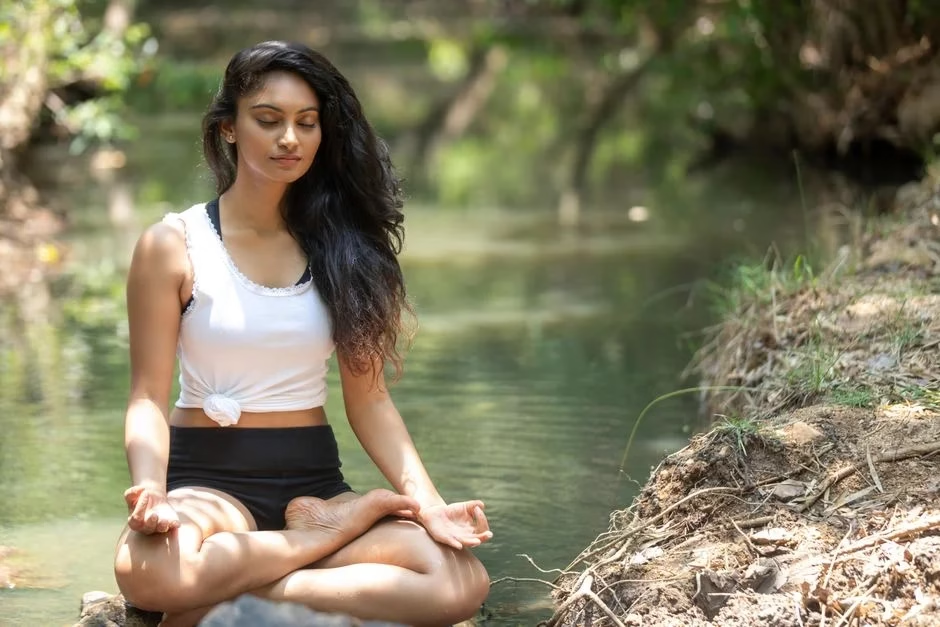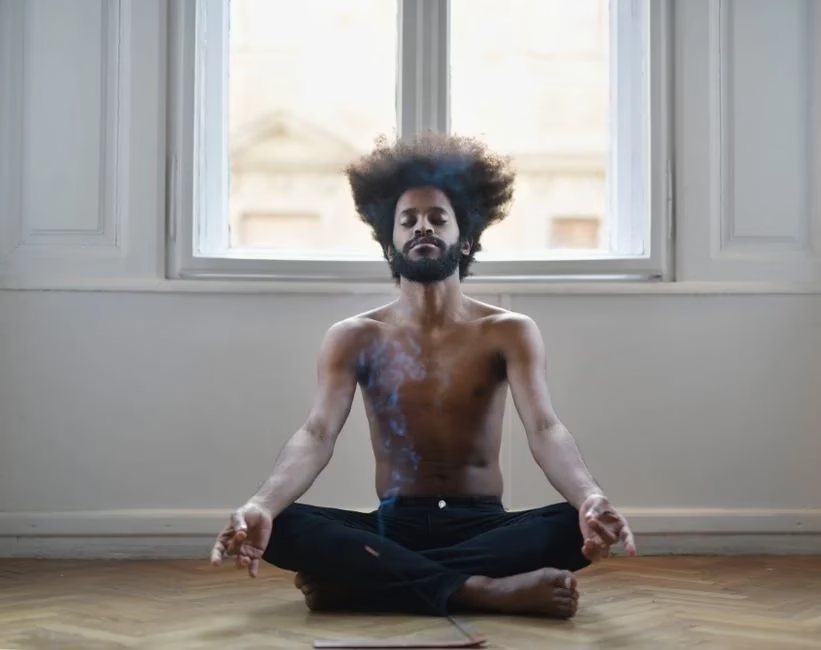
There’s a moment a lot of people recognise — lying awake at midnight, the same worried thought looping for the fourth time, unable to stop it no matter how hard you try. It doesn’t feel like a brain problem. It just feels exhausting. But that loop? That’s actually your brain doing something very specific. And mindfulness meditation for anxiety and depression works, in part, because it quietly changes that exact thing.
This isn’t about sitting cross-legged and thinking happy thoughts. The science goes much deeper than that. Over the last two decades, researchers have been able to put meditators inside brain scanners, and what they’ve found is genuinely surprising — physical changes, measurable shifts in brain structure, that help explain why so many people feel noticeably different after a consistent practice.
What follows is an honest look at how mindfulness meditation actually works in the brain, what it can realistically do for anxiety and depression, a few simple ways to begin today, and — just as importantly — who should take extra care before diving in.
Relevant blog to read: Mindfulness for Stress How It Changes Your Brain
Table of contents
- What Mindfulness Meditation Is Actually Doing to Your Brain
- Why Anxious and Depressed Brains Get Stuck — and How Mindfulness Helps
- A Few Simple Techniques to Try Today
- What Mindfulness Meditation Can't Do — and Who Should Take Extra Care
- What a Realistic Mindfulness Practice Actually Looks Like
- Frequently Asked Questions
- Related Reading
- Author's note
What Mindfulness Meditation Is Actually Doing to Your Brain
Most people assume mindfulness is about relaxation — a way to switch off and feel calm. That’s understandable, but it’s only a small part of the picture. What’s really happening when you meditate is closer to a workout for your brain’s control centre.
When you sit quietly and gently bring your attention back to your breath — again and again, without beating yourself up for getting distracted — you’re strengthening a part of the brain called the prefrontal cortex. Think of this area as the reasonable, measured voice in your head. The one that says “this isn’t as catastrophic as it feels right now.” The more you practise, the stronger that voice gets.
Neuroimaging studies have also found that regular meditators develop increased density of grey matter in the hippocampus — the part of the brain involved in memory and emotional regulation — and in a region called the insula, which helps you tune into what your body is actually feeling in any given moment. This is why mindfulness meditation brain changes for anxiety aren’t just theoretical. They show up on a scan.
Here’s the part that tends to stop people mid-scroll: a comprehensive review of 47 studies found that mindfulness-based programmes reduced symptoms of anxiety and depression with effects broadly comparable to antidepressant medication. That’s not a small claim. It means that for many people, a consistent, well-structured mindfulness practice can be genuinely powerful — not as a replacement for professional support, but as a real tool in its own right.
Why Anxious and Depressed Brains Get Stuck — and How Mindfulness Helps
You know that feeling when your mind keeps returning to the same painful thought, even when you desperately want it to stop? That’s called rumination, and it’s one of the most common features of both anxiety and depression. It’s not a character flaw. It’s your brain stuck in a loop it doesn’t know how to exit.
Mindfulness works on this loop in a really specific way. Rather than trying to fight the thought or push it away — which often makes it louder — mindfulness teaches you to notice the thought without automatically reacting to it. Researchers describe this as metacognitive awareness: the ability to observe your own thinking from a slight distance, the way you might watch clouds pass across a sky.
When that skill grows, something shifts. The thought still arrives, but you’re no longer fused to it. You can see it, name it, and let it move on — rather than climbing inside it and living there. Studies show that significant improvements in stress and coping responses can begin to appear within just three weeks of daily practice. That’s not a lifetime commitment. That’s a few minutes each morning.
It’s also worth understanding that the benefits of mindfulness meditation for depression aren’t just emotional. Chronic stress leaves fingerprints on the body — the chest that never quite unclenches, the breath that stays shallow all day, the sleep that never fully lands. The insula changes mentioned earlier mean that with practice, you actually become better at catching those signals early, before they build into something harder to manage. You notice the tension before it becomes a panic attack.
A Few Simple Techniques to Try Today
You don’t need an app, a retreat, or any previous experience. These are entry points — small, low-pressure ways to begin building the habit.
- The five-minute breath anchor: Set a timer for five minutes. Sit comfortably and focus on the physical sensation of breathing — the air moving in, the slight pause, the release. When your mind wanders (and it will — that’s normal), gently bring it back without any self-criticism. That act of returning is the whole practice.
- The STOP technique: This is a brilliant one for anxious moments during the day. Stop what you’re doing. Take one slow, deliberate breath. Observe what you’re thinking and feeling right now without judging it. Proceed with a little more intention than before. It takes thirty seconds and can genuinely interrupt a stress spiral.
- The 3-2-1 grounding reset: When anxiety spikes, pause and name three things you can see, two things you can hear, and one thing you can physically feel. This pulls your attention into the present moment — which is usually much safer than wherever your mind was just visiting.
- The mindful coffee habit: Pick one daily ritual — making tea, washing your hands, walking to the kettle — and commit to doing it with full sensory attention for two minutes. Notice the warmth, the smell, the sound. This is mindfulness meditation techniques for emotional regulation made practical and completely undramatic.
- The bedtime body scan: Lying down before sleep, slowly move your attention from the top of your head to your toes. You’re not trying to relax — just noticing what each area feels like. Heavy? Warm? Tight? No fixing required. Just noticing.
None of these require perfection. A wandering mind isn’t a failed meditation — it’s a normal mind doing what minds do. Every gentle return to the present is a small act of self-care that compounds over time.
What Mindfulness Meditation Can’t Do — and Who Should Take Extra Care
This part matters, and it would be dishonest to skip it.
Mindfulness is genuinely helpful for many people, but it’s not a universal solution. When researchers compare it directly to other active, well-structured stress-reducing activities, the effects are often similar — meaning mindfulness isn’t uniquely magic. It’s one solid tool among several, and what works best varies from person to person.
More importantly, for some people — particularly those carrying unresolved trauma — turning inward and sitting quietly with thoughts and body sensations can feel destabilising rather than calming. Documented adverse effects include panic attacks, intrusive memories, and a sense of detachment from yourself or your surroundings. These experiences are real, they’re not uncommon in certain contexts, and they deserve to be named honestly.
If you have a history of trauma, or if you’ve ever found that quiet stillness makes things feel worse rather than better, that’s worth paying attention to. Starting very gently — with brief, eyes-open, movement-based mindfulness rather than extended seated meditation — and working alongside a qualified therapist can make a significant difference. Mindfulness in that context can still be valuable; it just works better with proper support around it.
Knowing the limits of something isn’t a reason to dismiss it. It’s a reason to use it wisely.
What a Realistic Mindfulness Practice Actually Looks Like
Here’s something the wellness world rarely admits: mindfulness often feels worse before it feels better. In the first few days, you might become sharply aware of just how loud your mind actually is — how many anxious loops were already running in the background, unnoticed. That’s not failure. That’s the practice starting to work.
The evidence suggests that even brief daily sessions, practised consistently over weeks, begin to shift how you respond to stress. Not just in the moment, but as a default. The brain is adapting slowly, quietly, in the background. Research into Mindfulness-Based Stress Reduction — an eight-week structured programme — has shown that its effects on pain, anxiety, and mood can last up to fifteen months after the programme ends. The changes, when they take root, aren’t fleeting.
So if you’re starting with five minutes and a busy, distracted mind, you’re not doing it wrong. You’re doing it exactly right.
Frequently Asked Questions
Mindfulness meditation helps by strengthening the part of your brain that regulates emotions — the prefrontal cortex — while reducing the mental looping that keeps anxiety and depression going. Over time, you become better at noticing a difficult thought without automatically spiralling into it. This shift in how you relate to your own thinking is where most of the relief comes from, and it builds with consistent daily practice.
Research suggests meaningful changes in stress responses can begin within three weeks of daily practice — even with short sessions. You may notice you're reacting slightly less intensely to things that usually trigger you, or sleeping a little better. Deeper structural changes in the brain take longer, but the early signs often appear sooner than most people expect.
For most people, mindfulness is safe and calming. However, for individuals with unresolved trauma, turning attention inward can occasionally trigger panic, intrusive memories, or a sense of detachment. This is documented and real. If you have a trauma history, starting with short, eyes-open or movement-based practices — ideally alongside a therapist — is a gentler and safer entry point.
Honestly, the research shows it's broadly comparable to other well-structured, active approaches to stress relief — not clearly superior to them. What makes mindfulness valuable is that it's accessible, free, and builds a long-term skill. For many people it works beautifully alongside therapy, not instead of it. The best approach is whatever you'll actually keep doing consistently.
The 3-2-1 grounding technique is one of the most accessible starting points. When anxiety spikes, pause and name three things you can see, two things you can hear, and one thing you can physically feel. It pulls your attention into the present moment in under a minute. From there, a simple five-minute daily breath focus is the most research-supported way to build a lasting habit.
Related Reading
- Mindfulness for Stress How It Changes Your Brain
- Meditation for Depression How It Rewires Your Brain
- Science of Meditation Brain and Life
- Mindfulness for Anxiety What the Research Shows
Author’s note
Thank you for taking the time to focus on your well-being and for being your own cheerleader in this journey called life. I truly appreciate you for choosing to invest in yourself today, and I’m honored that you spent a part of your day here. Remember, every small step you take matters, and you’re doing an amazing job. Keep going—you’ve got this!