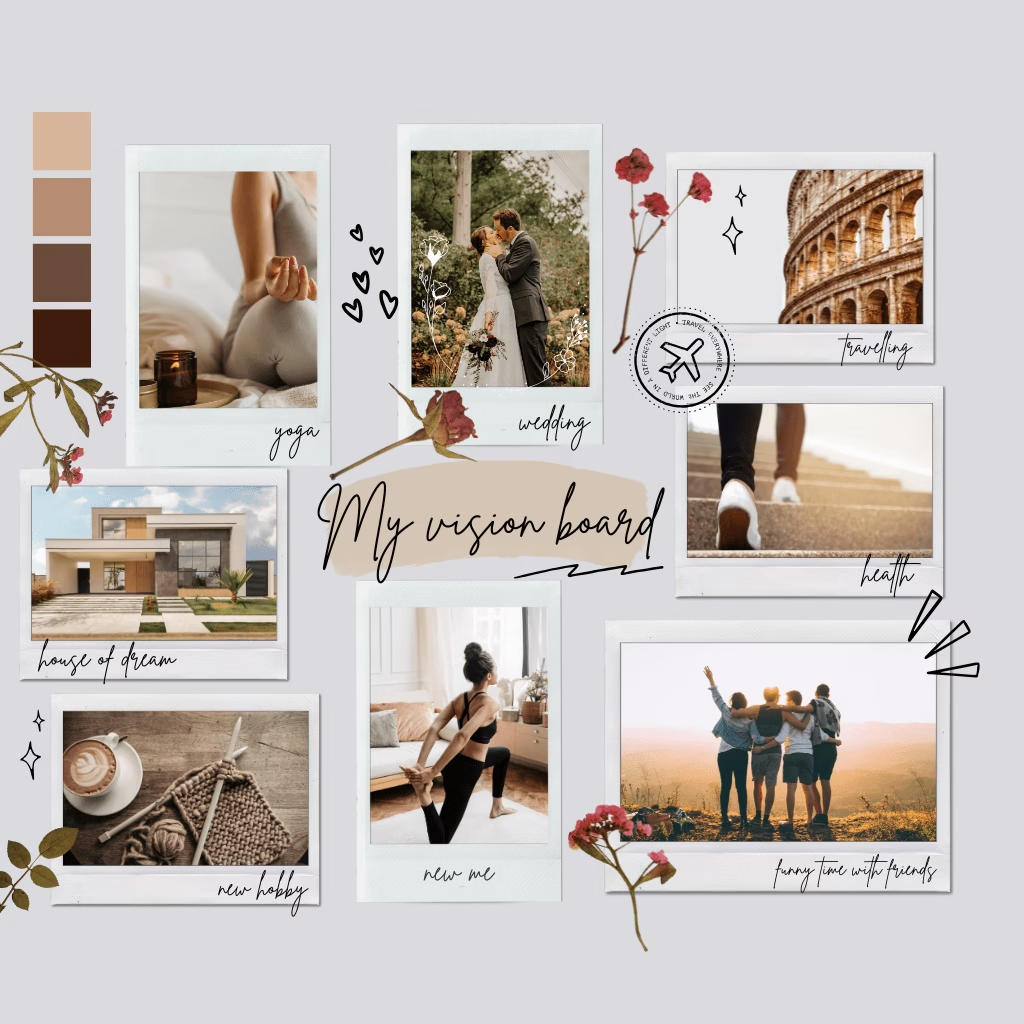
The standard vision board – a collage of pretty pictures – is a great start, but often falls short of being an effective manifestation tool. Why? Because it usually focuses only on the outcome (the new house, the vacation) without addressing the action and emotion required to get there. An effective vision board should act as a daily visual roadmap, not just a gallery of aspirations. By following this definitive Vision Board Checklist, you can transform a passive collage into a powerful, energetic anchor that aligns your subconscious mind with your goals.
Ready to stop passively pinning and start actively manifesting? Let’s dive into the 7 must-haves that every high-impact vision board needs.
Relevant blog to read: Create A New Year Vision Board For Peace and Boundaries
The 7 Must-Haves for Your Effective Vision Board Checklist
1. Specific, Measurable Goals (The GPS Coordinates)
Vague dreams yield vague results. The most crucial item on your Vision Board Checklist is specificity. Instead of a general picture of “wealth,” you need a clear target.
How to Implement:
- Use precise numbers and dates. A picture of a savings account balance showing “25,000” is better than a generic pile of money.
- If your goal is fitness, don’t just use a picture of a healthy person; use a picture of the exact race medal you plan to win or the specific weight number you aim to maintain.
Example: Instead of “I want to travel more,” include a postcard image of Paris with the words “Visit Paris: June 2026.”
2. Action-Oriented Imagery (The “Doing”)
Your board should depict not just the destination, but the journey. If all your images show the finished result, your brain has no roadmap for what to do today. Action imagery reminds you of the behaviors required for success.
How to Implement:
- For starting a business: Include images of focused work, brainstorming sessions, or typing furiously at a laptop—not just the logo.
- For professional growth: Include images of study materials, a person speaking confidently at a podium, or a specific certification logo.
3. Emotional Anchors (The “Feeling”)
Manifestation is driven by vibration and emotion. Your board must include elements that trigger the exact feeling you expect to have when you achieve your goal. This is perhaps the most overlooked item on any Vision Board Checklist.
How to Implement:
- Use words like “Peace,” “Abundant,” “Secure,” “Proud,” or “Free.”
- Find abstract art or colors that visually represent that emotional state for you (e.g., deep blue for peace, bright yellow for joy).
Example: If your goal is a new car, the feeling of security it gives you is more powerful than the car picture itself. Include an image of a person smiling with a sense of deep relief, captioned “Finally Secure.”
4. Personal Affirmations (First-Person, Present Tense)
Affirmations shift your subconscious beliefs. They must be written as if the goal has already been achieved, making them a cornerstone of this Vision Board Checklist.
How to Implement:
- Always use “I AM,” “I HAVE,” or “I FEEL.”
- Print or handwrite them clearly and prominently.
Examples:
- “I am a successful, seven-figure entrepreneur.”
- “I have the energy and focus to accomplish my goals every day.”
- “I feel completely balanced and at peace.”
5. A Focal Point (Your North Star)
Every great design needs a focal point. Your board should have one large, central image or phrase that represents your highest priority or your core identity (who you want to become).
How to Implement:
- Place the most important goal image (e.g., your life mission statement or your desired identity) directly in the center of the board.
- Make this image 2-3 times larger than any other element. Everything else radiates outward from this central theme.
Relevant blog to read: How to Use Vision Boards with Affirmations and the Law of Attraction
6. The “Why” Statement (Motivation Insurance)
When motivation lags, the Why keeps you going. The Vision Board Checklist must include a powerful reminder of the deep, intrinsic reason for pursuing your goals.
How to Implement:
- This can be a single sentence or a short quote.
- It should focus on the impact your success will have on others or your sense of self-worth, not just the material gain.
Example: If your “what” is “a profitable side business,” your “why” might be: “To create generational wealth and provide my parents with security.”
7. Obstacle/Challenge Acknowledgment (The Growth Mindset)
This is an advanced, but highly effective, item. Instead of pretending obstacles don’t exist, acknowledge the type of growth required. This trains your brain to anticipate challenges with resilience.
How to Implement:
- Use powerful growth phrases rather than dwelling on the negative.
- Place a small section dedicated to growth areas.
Examples:
- “I embrace learning to delegate effectively.” (If delegation is hard)
- “I remain calm and resourceful under pressure.” (If stress management is a challenge)
- “I maintain boundaries to protect my energy.”
Conclusion
Creating a vision board is more than a fun craft project—it’s a sacred contract with your future self. By ensuring your board meets every requirement in this definitive Vision Board Checklist, you move past wishful thinking into deliberate creation. Now, take your new, optimized board and place it somewhere you can see it first thing in the morning and last thing at night. Use it, feel it, and watch the world align with your new, powerful vision.
Frequently Asked Questions (FAQs)
You should look at your vision board at least twice a day: once in the morning to set your daily intention and once before bed to program your subconscious mind while you sleep. Spend 3-5 minutes visualizing and feeling the emotions associated with the finished goals.
The most effective method is usually a physical, tactile board (poster board, corkboard). The act of physically cutting out images and pasting them creates a stronger neural connection. However, a digital board (used as a desktop background or phone wallpaper) is an excellent supplementary tool for on-the-go viewing.
Author’s note
Thank you for taking the time to focus on your well-being and for being your own cheerleader in this journey called life. I truly appreciate you for choosing to invest in yourself today, and I’m honored that you spent a part of your day here. Remember, every small step you take matters, and you’re doing an amazing job. Keep going—you’ve got this!