You don’t have to be able to draw a straight line. You don’t need talent, a studio, or any idea what you’re doing. What you need — and what art therapy for mental health actually asks of you — is just a willingness to pick something up and see what comes out.
Most people assume art therapy is a soft, feel-good activity that sits somewhere between a hobby and a spa day. That’s a reasonable guess, but it misses something important. When it’s done well, art therapy is a structured, clinically guided process that helps your brain do things that talking alone sometimes can’t — like finding words for feelings you didn’t know you had, or releasing tension that has been living in your body for years.
This post walks you through what art therapy actually is, what the research genuinely shows (including where the evidence is still thin), how it works inside your nervous system, and some grounded, practical exercises you could try today — whether you’re managing anxiety, working through low mood, or simply feeling stuck in a way you can’t quite name.
Relevant blog to read: Art Therapy for Mental Health
Table of contents
What Art Therapy for Mental Health Actually Is
Here’s the most common misconception worth clearing up first: making art at home and attending formal art therapy are not the same thing. Both have value, but they’re different animals.
- Formal art therapy: Delivered by a registered or licensed art therapist who combines creative methods with psychological assessment, treatment goals, and clinical support. The art is a tool inside a therapeutic relationship — not the whole picture.
- Self-directed creative activity: Drawing, painting, collaging, or crafting on your own. This can genuinely support relaxation, self-reflection, and mood — but it isn’t a clinical treatment and shouldn’t be treated as one.
- The process, not the product: In either setting, what matters is what the act of creating stirs up for you — not whether the finished piece looks good. A trained therapist will ask what a colour or image means to you, never what it’s supposed to symbolise.
That distinction matters because it protects you. If you’re carrying something heavy — trauma, persistent low mood, thoughts that frighten you — a trained professional can hold that space safely in a way a sketchpad alone cannot.
How Does Art Therapy Work? The Science in Plain English
When something painful happens, your brain sometimes struggles to file it away neatly in words. Language lives in one part of the brain; intense emotion and memory live somewhere older and deeper. Art gives those deeper parts a way to speak.
Researchers describe several mechanisms — that’s just a fancy word for “reasons it helps” — that explain the benefits of art therapy for mental health:
- Emotional labelling: Giving a feeling a shape, colour, or texture helps your brain identify and name it. And naming an emotion, even on paper, actually reduces its intensity. You’re essentially turning a vague inner storm into something you can look at from the outside.
- Externalising difficult experiences: When something that lives inside you becomes an object in the world — a drawing, a collage, a lump of clay — it feels slightly less overwhelming. You’re no longer trapped inside it. You’re standing next to it.
- Agency and self-efficacy: Choosing what to draw, what colour to use, when to stop — these small decisions rebuild a sense of control. For anyone who has felt powerless, that matters more than it might sound.
- Mindful attention: Focused creative activity pulls your mind into the present. When you’re watching watercolour bleed across paper, it’s hard to simultaneously replay yesterday’s argument or rehearse tomorrow’s worry.
- Social connection: Group art therapy can reduce isolation in a gentle way — you’re creating alongside others without needing to find the right words first.
These mechanisms are real and plausible. But it’s worth being honest: they don’t mean every art activity produces a clinical effect for every person. What works depends enormously on the person, the setting, and the support around them.
What the Research Really Shows
The evidence for art therapy is genuinely encouraging — and genuinely complicated. It’s worth knowing both sides.
A 2024 systematic review and meta-analysis published in JAMA Network Open pulled together 50 studies involving 2,766 people and 217 different outcomes. Active visual art therapy was associated with meaningful improvement in a portion of those outcomes — but the researchers were careful to note that the evidence was markedly varied across studies and generally rated as low quality. That doesn’t mean art therapy doesn’t work; it means we need better research to say exactly who it helps most and why.
A separate 2024 meta-analysis looked specifically at art therapy for depression, drawing on 15 randomised controlled trials involving 932 participants. It found a statistically significant reduction in depressive symptoms. The effect size was meaningful. The evidence quality was again rated as low — but the direction of the finding is consistent and worth taking seriously.
A randomised controlled trial in adult women found that art therapy reduced anxiety, improved their sense of quality of life, and increased their ability to access emotion-regulation strategies — that is, it gave them more tools to manage how they felt — compared with women on a waiting list who received no treatment.
The honest summary: art therapy shows real promise for depression and anxiety. It won’t fix everything, and it isn’t a substitute for therapy, medication, or crisis support when those are what you actually need. Think of it less like a treatment and more like a door — one that opens onto something the other tools in your life might not reach.
Art Therapy Exercises for Anxiety and Low Mood You Could Try Today
You don’t need to wait for a formal referral to begin exploring what creative expression feels like. These art therapy activities for adults are low-pressure, gentle, and designed to support — not replace — any professional care you’re already receiving.
1. The Ten-Minute Feeling Map
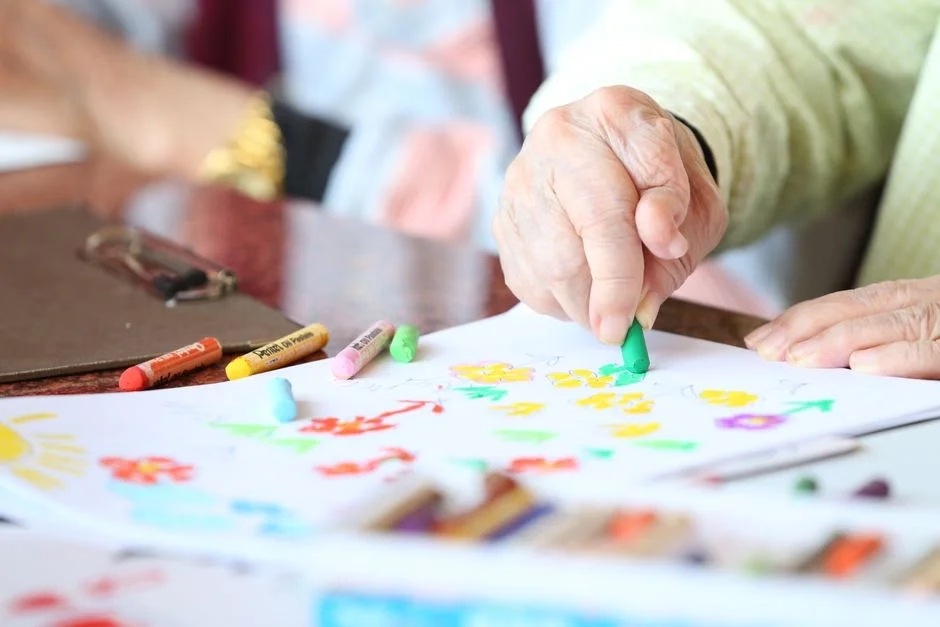
Set a timer for ten minutes. Using any drawing materials — even a biro on the back of an envelope — draw lines, shapes, or patches of colour that match how your body feels right now. Not what you think. What you feel. When the timer stops, write down one emotion and one physical sensation you notice. That’s it. The point isn’t the drawing. The point is the noticing.
2. The Two-Panel Check-In
Draw two simple panels side by side — they can be stick figures, blobs, anything. In the first panel, show how a stressful situation feels right now. In the second, show what even a small improvement might look like. Beneath the second panel, write one tiny, achievable step. This exercise works well for art therapy exercises for anxiety because it gently moves your mind from stuck to possible.
3. The Calming Resource Board
Cut or print images, words, colours, and textures that make you feel even slightly safer or calmer — a place you love, a person who makes you feel seen, a phrase that steadies you, a colour that soothes. Arrange them however you like. This isn’t decoration; it’s a grounding tool you can return to when things feel wobbly.
4. Repetitive, Rhythmic Creating
Colouring patterns, kneading clay, watercolour washes, knitting — repetitive creative activity has a naturally calming effect on the nervous system. Try pairing it with slow, deliberate breathing: breathe in for four counts, out for six. If distress rises rather than eases, stop and do something grounding instead. Your comfort always comes first.
One important note: if any of these exercises bring up memories or feelings that feel overwhelming, please reach out to a licensed mental health professional rather than pushing through alone. Some experiences need a trained person in the room with you, and that’s not a weakness — it’s wisdom.
How to Know If It’s Working
Progress here almost never arrives as a dramatic breakthrough. It’s quieter than that — and easier to miss if you’re not paying attention. You sleep a little better. The spiral that usually swallows your whole evening burns out faster. You find a word, finally, for something you’ve been carrying around wordlessly for months. These aren’t small things dressed up as big ones. They’re the actual thing.
One of the most useful habits you can build — whether you’re trying self-guided exercises or attending sessions with a therapist — is keeping a simple art-and-mood log. After each creative session, jot down: what you did, how long you spent, your mood out of ten before and after, and one observation about tension, rumination, or how connected you felt. Patterns show up in the data before they show up in how you feel.
What progress is not: how good your artwork looks, or what a symbolic meaning someone else assigns to it. Your artwork belongs to you. Its meaning is yours to interpret, and only yours to share if and when you choose.
Frequently Asked Questions
Not even slightly. Art therapy is about the process of creating, not the quality of what you make. A trained art therapist is interested in what colours, shapes, or images mean to you personally — not whether the drawing is technically impressive. Many people find that the less they worry about the result, the more honest and useful the experience becomes.
Research suggests it can, particularly when used alongside other support. A 2024 meta-analysis of 15 randomised controlled trials found a significant reduction in depressive symptoms among people who received visual art therapy. A separate trial found meaningful reductions in anxiety and improvements in quality of life. The evidence is promising but still developing, so it works best as a complement to professional care rather than a standalone treatment.
Making art for pleasure is genuinely good for your wellbeing — but it's different from formal art therapy. Formal art therapy is delivered by a qualified therapist who integrates creative activity with psychological goals, clinical assessment, and a therapeutic relationship. Think of it this way: a relaxing walk is good for you, but it's not the same as working with a physiotherapist after an injury.
Start with a ten-minute free drawing session — use any materials and draw shapes or colours that match how your body feels right now. Afterwards, name one emotion and one physical sensation you notice. You could also try building a calming resource board using cut-out images, words, and colours that make you feel grounded. Keep it low-pressure, and stop if anything feels distressing.
No — and it's worth being clear on this. Art therapy works best as a complement to established care, not a replacement for it. If your symptoms are persistent, worsening, or linked to thoughts of self-harm, please contact a licensed mental health professional or a crisis service. Creative tools can support your wellbeing, but some situations genuinely need professional clinical support.
Related Reading
- Art Therapy for Mental Health
- Art Therapy for Mental Health
- New Years Mental Health Goals to Actually Keep in
- Childrens Mental Health Signs Every Parent Should Know
Author’s note
Thank you for taking the time to focus on your well-being and for being your own cheerleader in this journey called life. I truly appreciate you for choosing to invest in yourself today, and I’m honored that you spent a part of your day here. Remember, every small step you take matters, and you’re doing an amazing job. Keep going—you’ve got this!