You press play on a meditation. The voice is calm. The music is soft. You close your eyes — and within thirty seconds your brain is running through tomorrow’s to-do list, replaying an awkward conversation from last week, and quietly wondering if you’re doing this wrong. Sound familiar?
Here’s the thing most meditation guides don’t tell you: that wandering mind isn’t a sign you’ve failed. It’s literally the point. And more importantly, not every type of guided meditation works the same way for every person — especially when anxiety is in the picture. Guided meditation for anxiety can be genuinely helpful, but the version that helps you might look very different from what your friend swears by.
This post is about finding the approach that actually fits your nervous system right now — not a generic promise that meditation will fix everything, but an honest, practical guide to making it work for you.
Relevant blog to read: Positive Self Talk That Actually Works
Table of contents
What Guided Meditation Actually Does to Your Brain
Before we talk about how to do it, it helps to understand why it works — because when you understand the mechanism, the practice starts to make a lot more sense.
When you’re anxious, your brain is essentially stuck in a threat-detection loop. Your breathing becomes shallow, your muscles tighten, and your thoughts race. Guided meditation doesn’t switch that off. What it does is give your attention somewhere specific to land — a voice, a breath, a bodily sensation — so your brain has a chance to step out of the loop, even briefly.
The skill being trained isn’t stillness. It’s the act of noticing when your mind has wandered, and gently returning it. That moment of return — done again and again — is what gradually builds a calmer, more flexible nervous system over time. Studies reviewed by the U.S. National Center for Complementary and Integrative Health, drawing on more than 12,000 participants, found that mindfulness-based approaches consistently outperformed no treatment at all for both anxiety and depression. Not a miracle cure. A real, modest, meaningful improvement.
The most important word there is gradually. One session won’t transform you. But a five-minute practice done most days very likely will shift something over a few weeks.
Matching the Right Session to How You Feel Right Now
This is where most people go wrong. They pick a random guided meditation, feel vaguely weird during it, and conclude that meditation isn’t for them. The real issue is usually a mismatch between the session type and what their nervous system actually needs in that moment.
Think of it like choosing the right tool for the job. A hammer is great — but not for everything.
- For immediate stress or a racing mind: A short grounding or breathing practice works best. Something that anchors you in the present moment through your senses — what you can hear, feel, or see. A 5 minute guided meditation for beginners that focuses on breath or sensory awareness is a gentle, low-risk starting point.
- For anxious thoughts that spiral: Look for a session that gently names thoughts without chasing them. The guide will prompt you to notice a thought, label it simply as “thinking,” and return your attention — that labelling technique is surprisingly powerful for breaking the spiral.
- For harsh self-criticism or low mood: A self-compassion practice, sometimes called loving-kindness, can help shift the inner dialogue. If guided mindfulness meditation for depression feels like too much to start with, even a five-minute version can soften the edges of a difficult day.
- For getting to sleep: A body scan is usually the best fit. It moves attention slowly through each part of the body, which draws focus away from anxious thoughts and towards physical sensation. Guided meditation for sleep and relaxation works best when it’s part of a consistent wind-down routine — same time, same recording, low light.
- For panic or acute overwhelm: The best guided meditation for panic attacks tends to be external and sensory rather than inward-focused. A voice that gently describes what you can see, hear, and feel around you — rather than directing you deep into your body — is usually safer and more stabilising when panic is close to the surface.
A Simple Way to Actually Start (and Keep Going)
The biggest barrier to a consistent practice isn’t laziness. It’s that people treat meditation like a special event — something that requires the right mood, the right time, and enough spare minutes. You wait for a calm evening that never quite arrives, and then another week has gone by.
A far easier approach is to attach your session to something you already do every day. After you make your morning coffee. After you brush your teeth at night. Before you open your phone in the morning. You’re borrowing an existing habit to carry a new one.
Here’s a simple way to begin a 5 minute guided meditation for beginners:
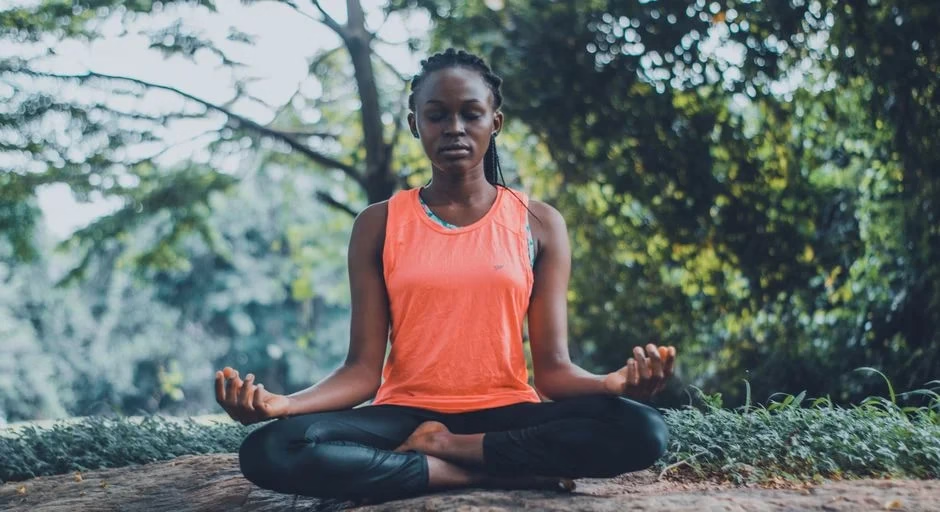
- Sit somewhere you won’t be interrupted. Back support helps. Both feet flat on the floor. If closing your eyes feels uncomfortable, just lower your gaze softly to the floor in front of you — eyes open is completely fine.
- Before you press play, write one sentence. Just one. Something like: “I want to notice tension without reacting to it.” This tiny step shifts your brain from passive to intentional, and it takes ten seconds.
- Follow the guide’s voice as an anchor. When your mind drifts — and it will — silently say “thinking” or “planning” to yourself, then return to the voice. No frustration needed. That return is the practice.
- After the session, notice one thing. Slower breathing? Slightly looser shoulders? Rate your stress from 0 to 10. Not to judge the session, but to start seeing the pattern across days.
A 2025 study from JMIR Mental Health found that using a guided meditation app daily for 30 days led to significant reductions in anxiety and stress, as well as better sleep quality. What matters is the repetition, not the perfection of each session.
When Meditation Feels Like It’s Making Things Worse
This part matters, and most articles skip over it entirely. For some people — particularly those with a history of trauma, panic attacks, or dissociation — turning attention sharply inward can sometimes increase distress rather than reduce it. If you’ve ever tried a body scan and felt suddenly more anxious, more aware of your own heartbeat than you wanted to be, more disconnected from the room around you — you’re not broken, and you’re not alone.
The solution isn’t to give up on meditation. It’s to adapt it.
- Keep your eyes open. Softly focused on a fixed point in the room. This simple change can make an enormous difference if closed eyes feel unsettling.
- Choose external over internal. Focus on sounds in the room, the feeling of your feet on the floor, or the temperature of the air on your skin — rather than internal bodily sensations.
- Go shorter. Two or three minutes is a completely legitimate session. There is no minimum to qualify.
- Stop without guilt. If a session consistently makes you feel worse — not just restless, but genuinely more distressed — that format is not right for you right now. Stop, get up, and do something grounding instead. A warm drink, a short walk, a familiar song.
Guided meditation for anxiety and stress is a tool, not a test. You are allowed to modify it, pause it, or set it aside while you find what fits better. If symptoms are persistent or severe, working with a therapist or doctor alongside any self-practice is always the wiser path.
The version of this practice that works is the one you can repeat on a Tuesday evening when you’re tired — not just on a calm Sunday morning. Start small, stay curious, and trust that even the messiest, most distracted five minutes still counts.
Frequently Asked Questions
Guided meditation is a practice where a recorded or live voice directs your attention — usually toward your breath, body, sounds, or an image — to help settle the mind. It works by giving your brain a specific anchor to return to whenever anxious thoughts arise. Over time, that repeated act of noticing and returning trains your nervous system to respond more calmly to stress.
Yes, it genuinely can — though the effect is gradual rather than instant. Research reviewed by the U.S. National Center for Complementary and Integrative Health, covering over 12,000 participants, found mindfulness-based approaches consistently outperformed no treatment for anxiety and depression. Short daily sessions, matched to your specific symptoms, tend to work better than long or infrequent ones.
Five minutes a day, done consistently, is genuinely enough to start. Consistency matters far more than duration. A five-minute session most days will likely serve you better than one long session on the weekend. The key sign that it's working isn't how each session feels — it's whether your stress levels, sleep, or anxiety intensity gradually shift over two to four weeks.
A body scan — where attention moves slowly through each part of the body — is usually the most effective format for sleep. It shifts focus away from racing thoughts and toward physical sensation. For best results, use the same low-stimulation recording as part of a consistent wind-down routine, at the same time each night, with the lights already low.
For some people, yes — particularly those with trauma histories, panic symptoms, or dissociation. Turning attention sharply inward can occasionally intensify distress rather than ease it. If this happens, try keeping your eyes open, focusing on external sounds or sensations instead of internal ones, and shortening the session. These adjustments often resolve the issue. If distress persists, speaking to a mental health professional is a sensible next step.
Related Reading
- Positive Self Talk That Actually Works
- Stress Management Techniques That Actually Work
- Positive Psychology Interventions That Actually Work
- Conflict Resolution Skills That Actually Work
Author’s note
Thank you for taking the time to focus on your well-being and for being your own cheerleader in this journey called life. I truly appreciate you for choosing to invest in yourself today, and I’m honored that you spent a part of your day here. Remember, every small step you take matters, and you’re doing an amazing job. Keep going—you’ve got this!