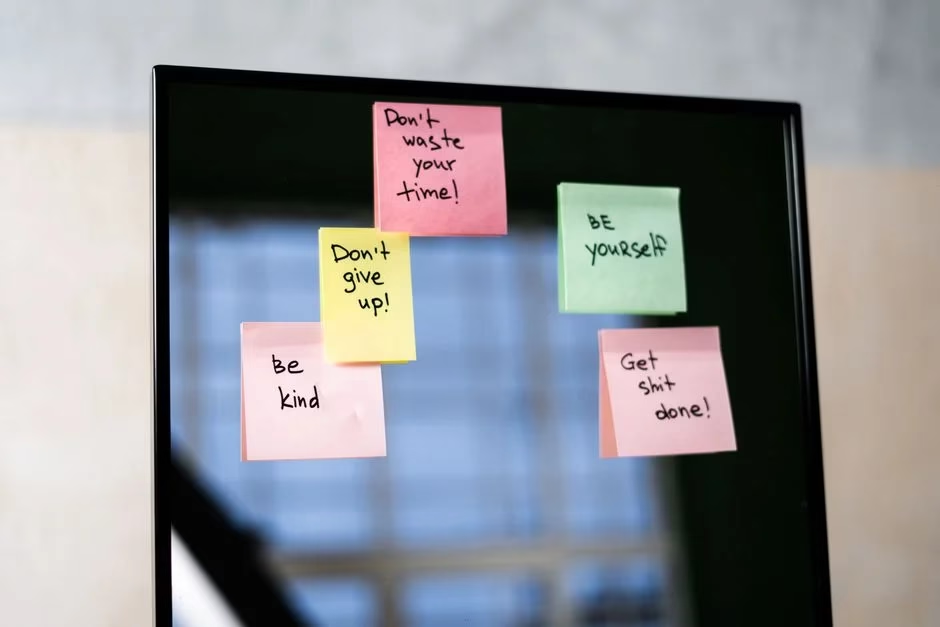
You made a list. You felt hopeful. Then life happened — a rough week, a low mood, a day where getting out of bed counted as a win — and the list just sat there, quietly judging you. Sound familiar?
That creeping guilt after a missed goal is one of the most common reasons people give up on goal setting for mental health altogether. And that’s a real shame, because when goals are built the right way — gently, flexibly, and around your actual life — they can be one of the most grounding tools you have.
This post is going to walk you through why the traditional “set it and crush it” approach doesn’t work well for mental health recovery, what actually does work, and how to build goals that hold up even on your worst days. No pressure. No perfection required.
Relevant blog to read: Mental Health Goal Setting Reduce Anxiety Find Purpose
Table of contents
- The Problem With How We're Usually Taught to Set Goals
- Why Process Goals Are a Game-Changer for Mental Health
- What SMART Goals for Mental Health Actually Look Like
- How to Set Goals When Depression or Anxiety Makes Everything Feel Hard
- The Weekly Review That Replaces Self-Criticism
- Frequently Asked Questions
- Related Reading
- Author's note
The Problem With How We’re Usually Taught to Set Goals
Most of us grew up thinking a goal meant something big, bold, and measurable — lose 10 kilos, get promoted, run a marathon. And if you didn’t hit it, that said something about your willpower or your character. That kind of thinking is genuinely harmful when you’re working through anxiety, depression, or burnout.
Here’s the thing that often gets missed: missing a goal deadline doesn’t mean you failed. It usually means the goal wasn’t the right size or shape for where you were at that moment. That’s not a personal flaw — it’s just information. The goal needed adjusting, not you.
Mental health recovery is rarely a straight line. Your energy, motivation, and capacity change from week to week — sometimes from hour to hour. A goal-setting approach that doesn’t account for that is working against you, not for you.
Why Process Goals Are a Game-Changer for Mental Health
Here’s the most important idea in this whole post, and it’s one that many people have never heard: focus on what you do, not on how you feel.
A process goal is something you can actually control. “Feel less anxious” is an outcome — it depends on your brain chemistry, your circumstances, a hundred things outside your hands. “Practice five minutes of slow breathing after lunch” is a process. You can do that even on a difficult day. And doing it, repeatedly, is what gradually builds the calm you’re hoping for.
Mental health professionals often prioritise process goals precisely because of this. When you complete a small, doable action, you get a tiny hit of mastery — a quiet sense of “I did that.” Over time, those small moments stack up into something that actually feels like progress.
- Outcome goal: “I want to feel less depressed.”
- Process goal: “I’ll send one text to a friend this week.”
- Outcome goal: “I want to stop worrying so much.”
- Process goal: “I’ll write three things I noticed today in a notebook before bed.”
See the difference? The process goal is something you can tick off. It doesn’t depend on your mood cooperating. That matters enormously when symptoms fluctuate.
What SMART Goals for Mental Health Actually Look Like
You may have heard of SMART goals — Specific, Measurable, Achievable, Relevant, Time-bound. They’re useful, but only when you use them as a gentle guide rather than a rigid performance test. Here’s how each piece actually helps when you’re managing your mental health.
- Specific: Instead of “exercise more,” try “walk to the end of the street and back on Monday, Wednesday, and Friday.” A specific goal tells your brain exactly what to do, so there’s no decision fatigue on a hard day.
- Measurable: Keep it simple. A check mark in a notebook is enough. You’re not running a corporate report — you’re just giving yourself evidence that you showed up.
- Achievable: This is the big one. Your goal needs a “minimum version” — the smallest possible action that still counts on a really bad day. Two minutes of breathing still counts. One sentence in a journal still counts.
- Relevant: The goal has to matter to you, not to what you think you’re supposed to want. Ask yourself: why does this actually matter to my life right now?
- Time-bound: Set a review date, not a deadline. “I’ll check in on this goal on Sunday” feels very different from “I must achieve this by Sunday.” One invites reflection. The other sets you up to feel like a failure.
A systematic review that looked at 54 studies on goal planning in mental health settings found benefits across a wide range of conditions and care settings — including improvements in how people felt about their own ability to reach goals, their mood, and their sense of meaning in life. That research matters because it tells us this isn’t just motivational fluff. Done well, goal setting is a legitimate mental health tool.
How to Set Goals When Depression or Anxiety Makes Everything Feel Hard
You know that feeling when someone cheerfully tells you to “just set a goal and go for it” and you’d quite like to throw something at them? When depression is heavy or anxiety is loud, even small tasks can feel enormous. The answer isn’t to push harder. It’s to go smaller.
Think of it this way: if you’re running on 20% battery, a goal that requires 80% effort is going to drain you flat. A goal that needs 15%? That you can actually do. And doing it — completing the small thing, the embarrassingly small thing — builds just enough momentum to try something slightly bigger next time. Not because you’ve fixed anything. Just because you proved to yourself that you still can.
A simple way to build your first goal today
- Write one sentence about what you’d like to be a little different, and why it matters to you personally.
- Turn it into an action that starts with a verb — walk, call, write, breathe, attend, schedule. Verbs make things real.
- Find the minimum version. What’s the tiniest form of this that still counts? That’s your floor, not your ceiling.
- Attach it to something you already do — after making tea, after brushing your teeth, when you close your laptop. Linking a new habit to an existing one makes it much easier to remember.
- Track it with a check mark, not a score. You did it or you didn’t. There’s no grade.
One more thing worth knowing: research looking at a digital health programme found that 79% of people who set goals chose just one goal. Not five. Not a whole list. One. That’s not laziness — that’s wisdom. Narrowing your focus to a single priority is often what makes the difference between a goal that stays on paper and one that actually happens.
The Weekly Review That Replaces Self-Criticism
Most people either never look back at their goals (so they drift) or look back and spend ten minutes cataloguing everything they didn’t do. Neither works. What does work is five minutes, once a week, where you sit with your goals like they’re a friend you’re checking in on — not a test you’re marking.
Try asking yourself these four questions:
- What helped this week? Even if things went sideways, something probably supported you. Name it.
- What got in the way? Not to blame yourself — just to understand. Barriers are information, not verdicts.
- Does this goal still feel relevant? It’s okay if your priorities have shifted. Goals are allowed to change.
- What would make next week’s step feel slightly easier? Smaller? Different timing? More support?
This kind of review isn’t about grading yourself. It’s about staying in an honest, compassionate conversation with yourself about what’s working. That’s exactly how good therapy works too — not judging whether you hit a target, but learning together what the next right step might be.
If you’re working with a therapist or counsellor, sharing your goals with them can make that relationship even more useful. And if you’re not currently in professional support but you’re finding that low mood, anxiety, or difficult thoughts are making daily life consistently hard, that’s a sign that goals alone won’t be enough — and that’s completely okay. Goals work best as one part of a wider picture that might include professional support, good sleep, connection with others, and whatever else genuinely helps you.
Start with one small, honest goal. Review it without cruelty. Adjust it without shame. That’s not settling for less — that’s how real, lasting change actually begins.
Frequently Asked Questions
Start smaller than you think you need to. Depression reduces energy and motivation, so a goal that feels easy on a good day can feel impossible on a hard one. Choose a minimum version of the action — something that still counts even when you're running low. One text sent, two minutes of breathing, a single sentence written. Tiny and done beats ambitious and abandoned every time.
SMART stands for Specific, Measurable, Achievable, Relevant, and Time-bound. In a mental health context, the most important letters are A and R — your goal needs to be genuinely doable given your current energy and symptoms, and it needs to matter to you personally. Use SMART as a gentle guide, not a rigid test. A review date is more helpful than a hard deadline.
Good mental health goal examples tend to focus on actions, not feelings. Try: 'I'll go for a ten-minute walk three times this week,' 'I'll write in my journal for five minutes before bed on weekdays,' or 'I'll attend my therapy session and share one honest thing.' These are all process goals — things you control — rather than outcomes like 'feel happier,' which depend on too many variables.
Failing to reach a goal usually means the goal wasn't matched to your actual capacity — not that something is wrong with you. If symptoms, stress, or circumstances shifted after you set the goal, the goal needed adjusting, not you. Try building in a minimum version of every goal — the smallest action that still counts — and review your goals weekly so you can adapt them before they start to feel impossible.
Yes, when it's done in a way that fits your life. A review of 54 studies on goal planning in mental health settings found improvements in mood, sense of purpose, and people's belief in their own ability to cope. The key is that goals work best when they're personally meaningful, realistic, and reviewed regularly — not when they're used as a measuring stick for whether you're trying hard enough.
Related Reading
- Mental Health Goal Setting Reduce Anxiety Find Purpose
- Mental Health Goal Setting Start Small Win Big
- New Years Mental Health Goals to Actually Keep in
- Work Life Balance Mental Health
Author’s note
Thank you for taking the time to focus on your well-being and for being your own cheerleader in this journey called life. I truly appreciate you for choosing to invest in yourself today, and I’m honored that you spent a part of your day here. Remember, every small step you take matters, and you’re doing an amazing job. Keep going—you’ve got this!