Your four-year-old is melting down on the kitchen floor. Dinner is burning. Your phone is buzzing. And somewhere in the noise, you feel that familiar heat rising in your chest — the one that comes just before you say something you’ll wish you hadn’t. Every parent knows this moment. And most parents feel quietly ashamed of how it ends.
Here’s the thing nobody talks about enough: mindful parenting wasn’t designed for the easy moments. It wasn’t made for peaceful Sunday mornings or gentle bedtime stories. It was designed precisely for that kitchen floor moment. For the transitions that go sideways. For the homework battles and the repeated questions and the sibling arguments that never seem to end.
This post is about what mindful parenting actually looks like when real life is happening — not as a vague wellness idea, but as a practical, nervous-system skill you can use today, in the middle of the mess.
Relevant blog to read: Positive Psychology Interventions That Actually Work
Table of contents
- What Mindful Parenting Really Means (It's Not What You Think)
- Why Your Nervous System Is at the Centre of All of This
- How to Practice Mindful Parenting in the Hardest Moments
- What Mindful Parenting Does for Your Child Over Time
- A Simple Way to Start Today
- Frequently Asked Questions
- Related Reading
- Author's note
What Mindful Parenting Really Means (It’s Not What You Think)
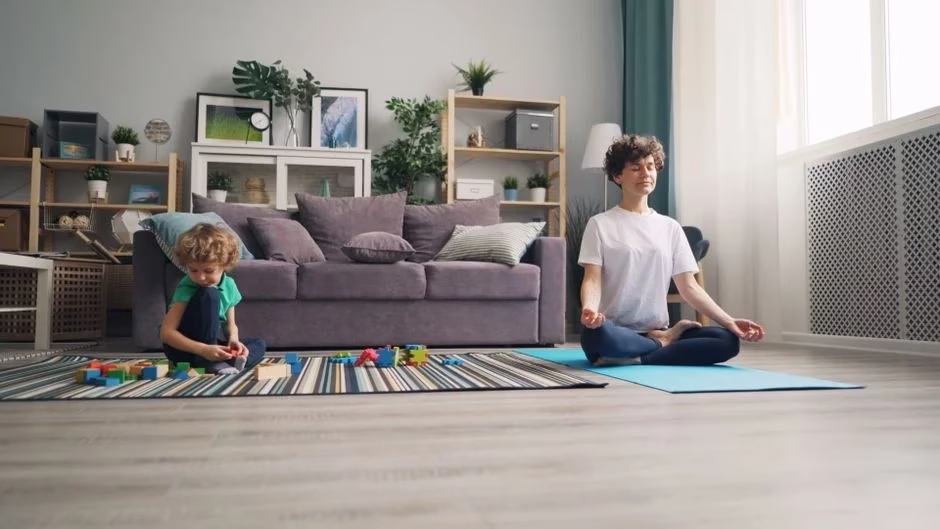
A lot of people hear “mindful parenting” and picture a serene parent sitting cross-legged, smiling softly while their child quietly colours. That’s not it. That’s not even close.
Mindful parenting means noticing what’s happening inside you — your frustration, your exhaustion, your rising voice — before it takes over. It’s the pause between the trigger and the reaction. That pause, even if it’s just two seconds long, is where everything changes.
One common misconception is that mindful parenting means letting children do whatever they want. It doesn’t. Research consistently links it to warmer relationships and more consistent boundaries — not fewer boundaries. Another misconception is that you need to stay calm all the time. You don’t. You just need to notice, sooner, when you’re not calm.
Think of it less like a personality trait and more like a muscle. You can build it. You can practice it in small moments every single day. And the more you do, the less those kitchen floor moments feel like they’re running the whole show.
Why Your Nervous System Is at the Centre of All of This
When a child screams, argues, or refuses to move — your brain reads it as a threat. Not metaphorically. Literally. The stress response kicks in. Your heart rate goes up. Your breathing gets shallow. Your thinking narrows. In that state, the part of your brain responsible for patience and clear thinking goes offline, and the part responsible for survival takes over.
That’s why you can know, intellectually, that your toddler is just tired — and still find yourself raising your voice anyway. It’s not a character flaw. It’s biology.
This is exactly why mindful parenting works at the level of the nervous system, not just the mind. When you take one slow breath before responding, you’re not just buying time. You’re physically signalling to your body that the threat isn’t real. Your heart rate drops slightly. The thinking brain comes back online. And from there, you can choose a response instead of just reacting to one.
A 2021 meta-analysis of 20 studies found that mindfulness-based parenting programmes had moderate effects on general stress, internalising symptoms, and overall wellbeing — and that the benefits for parenting stress actually grew stronger over time after the programme ended. That last part matters: the skills consolidate in real life, in real moments, the more you use them.
How to Practice Mindful Parenting in the Hardest Moments
You don’t need a meditation cushion or a quiet house. The best place to practice mindful parenting is in the exact moments that feel the most impossible. Here’s what that looks like in practice.
During a Tantrum or Meltdown
When a young child melts down — whether they’re two or seven — your body responds to their distress with distress of its own. That’s co-regulation working in reverse. But when you regulate first, you give their nervous system something to synchronise with.
- Take one breath before you speak: Breathe in slowly, let your shoulders drop. This isn’t dramatic — nobody even has to notice you’re doing it.
- Lower your voice instead of raising it: A quieter voice signals calm. It’s counterintuitive, but it works. Children tend to match the volume they hear.
- Name your own state silently: Say to yourself, “I’m getting reactive” or “I’m overwhelmed right now.” Naming a feeling reduces its intensity — this is well-supported by research on how the brain processes emotion.
- Give one instruction at a time: Especially with toddlers, too many words during a meltdown adds to the overload. One clear, calm sentence is enough.
During Transitions and the Witching Hour
The window between school pick-up and dinner isn’t chaos by accident — it’s three people who are hungry, overstimulated, and done with being managed, colliding with one adult who’s been holding it together all day and has about forty minutes left in the tank. Of course it goes sideways. But because it’s predictable, it’s also trainable.
- Choose one daily routine to give your full attention: Pick meals, bedtime, or the school drop-off. Put the phone down. Be fully there. Just one routine, done mindfully each day, can genuinely shift the feel of your relationship with your child.
- Wait for eye contact before giving instructions: This slows the interaction down and makes it more likely your child actually hears you — reducing the need to repeat yourself five times.
- Use a ten-second pause before responding to repeated complaints: Rather than snapping, pause. The pause itself often defuses the moment.
After a Rupture — The Repair That Changes Everything
Here’s possibly the most important part of mindful parenting that almost nobody talks about: what happens after things go wrong.
Every parent loses it sometimes. Every parent says something too sharp or exits the room in frustration. That’s not failure. What matters — for your child’s emotional development and for your relationship — is what you do next.
Repair is the act of coming back. It doesn’t need to be a long, formal conversation. It can be as simple as sitting next to your child ten minutes later and saying, “That was a hard moment. I got frustrated. I love you.” That’s it. Studies on parenting and emotional security consistently show that it’s not the absence of conflict that builds secure attachment — it’s the repair afterwards.
End one interaction each day with a small repair moment. Apologise for a snappy comment. Acknowledge that a transition was hard. Reconnect after a discipline moment with warmth. These micro-repairs, done consistently, are where the deepest benefits of mindful parenting actually live.
What Mindful Parenting Does for Your Child Over Time
When a parent regulates their own stress more effectively, children don’t just feel better in the moment — they actually develop better over time. Research on mindful parenting and child outcomes links it to fewer behavioural difficulties, better emotional regulation in children, and stronger social skills.
Why? Because children learn emotional regulation by being around it. When they repeatedly experience a parent who pauses, names feelings, and repairs after conflict — they internalise that pattern. They start doing it themselves.
- Mindful parenting benefits for children include: fewer outbursts, improved ability to handle frustration, stronger connection with the parent, and better emotional awareness as they grow.
- It works even in high-stress families: Research suggests families dealing with higher levels of stress or child behaviour difficulties tend to see the largest gains — so if things feel hard right now, that’s not a reason to doubt this approach. It’s actually a reason to lean into it.
A 2021 review also found that higher levels of mindful parenting were consistently linked to lower harsh parenting and higher warmth and positive engagement — not because parents became different people, but because they had more awareness in the moments that matter most.
A Simple Way to Start Today
You don’t need a programme or a course or a perfectly structured day. Pick the one daily moment that most reliably unravels in your house — the one where you can already feel it going wrong before it’s even started. The morning rush. Homework. Bedtime. Just one. And for the next week, bring a single thing to that moment: one slow breath before you speak, or one full minute of undivided attention, or one repair sentence before the day ends.
Not a new version of yourself. Not a calmer personality. Just one moment, handled slightly differently, repeated enough times that it starts to stick.
That’s where mindful parenting begins — not on a cushion, not in a quiet room, but in the ordinary, noisy, beautiful chaos of a real family day.
Frequently Asked Questions
Mindful parenting means bringing present-moment awareness to your interactions with your child — especially in stressful ones. It works by helping you notice your own emotional reactions before they take over, so you can respond more deliberately rather than just reacting. It's not about being calm all the time. It's about catching yourself sooner when you're not, and making a slightly better choice from there.
Yes, and the research backs this up. When parents regulate their own stress response during a meltdown — by slowing their breath, lowering their voice, and staying physically calm — children often settle more quickly. Over time, children raised with mindful parenting tend to develop better emotional regulation themselves, which means fewer and shorter meltdowns as they grow.
Start with one breath before you speak — just one. You don't need to feel calm to do this. Name your internal state silently, like 'I'm overwhelmed right now.' That small act of naming reduces the intensity of the feeling. Then lower your voice and give one clear instruction. You don't have to get it perfect. Even a partial pause is more effective than no pause at all.
They overlap but they're not the same thing. Mindful parenting focuses specifically on a parent's own emotional awareness and regulation in the moment. It's compatible with firm, consistent boundaries — in fact, research links it to warmer and more consistent discipline, not less of it. Gentle parenting is a broader style. Mindful parenting is more of a skill set you bring to whatever parenting style feels right for your family.
Children with mindfully aware parents tend to have fewer behavioural difficulties, better emotional regulation, and stronger social skills. This happens partly because children learn how to handle big feelings by watching the adults around them do it. When a parent consistently pauses, names emotions, and repairs after conflict, children internalise that pattern and start applying it to their own relationships over time.
Related Reading
- Positive Psychology Interventions That Actually Work
- Emotional Well Being Nervous System Recovery
- Conflict Resolution Skills That Actually Work
- Self Motivation Techniques That Actually Work
Author’s note
Thank you for taking the time to focus on your well-being and for being your own cheerleader in this journey called life. I truly appreciate you for choosing to invest in yourself today, and I’m honored that you spent a part of your day here. Remember, every small step you take matters, and you’re doing an amazing job. Keep going—you’ve got this!